Overview
Live on Berachain: SukukFi is in production at https://app.sukuk.fi. See Product Status for what is available today.
SukukFi is a credit marketplace on Berachain where telecom technology companies borrow working capital to fund supplier invoices, and DeFi depositors earn profit share when buyers settle. All instruments are structured on Islamic finance principles, under Mudarabah or Murabaha. No independent Sharia supervisory board has certified any SukukFi vault; see How SukukFi Aligns for certification status.
One vault is live today: the PrimeTel vault, which finances wholesale voice-minutes purchases. You deposit USDT0, USDC.e, or HONEY and receive duPRT, the bond share token. Bond tokens are composable across DeFi: usable as collateral elsewhere, with a Kodiak market planned but not yet live.
Yield comes from actual business profit share, not token emissions or fixed interest. The target range is 10-20% annualised. We aim to operate within this range. Each vault sets its own target by reference to its obligor and settlement terms, and that target is published in the vault’s terms; the live Phase 1 PrimeTel vault targets 21% gross. Returns vary by pool performance and deployment timing.
This documentation covers how to deposit, how redemption works, the fee structure, the Sharia framework, and the on-chain contracts. Start with Getting Started or go to Live Pools to see what’s available now.
Query SukukFi from an AI assistant
SukukFi runs a public MCP server with live vault data and this documentation:
claude mcp add --transport http sukukfi https://mcp.sukuk.fi/mcp --scope user
See MCP Server for the available tools.
Getting Started
SukukFi is live on Berachain mainnet. One vault is open for deposits today: the PrimeTel vault, accepting USDT0, USDC.e, and HONEY.
To deposit
- Open the app: https://app.sukuk.fi
- Check what’s live: Product Status and Live Pools
- Read the pool page: PrimeTel Vault covers structure, fees, and risk
- Connect your wallet: Berachain Mainnet (chain ID 80094). If your stablecoins are on another chain, bridge via Stargate Finance first.
- Deposit: Full steps in How to Deposit
For businesses
Telecom technology companies seeking working capital should read Eligibility Criteria and contact us via Contact & Support.
Product Status
SukukFi is live on Berachain Mainnet. Use the production app at https://app.sukuk.fi.
Live today
- PrimeTel vault: Mudarabah postpaid voice-minutes financing (pool documentation)
- Three deposit assets: USDC.e, USD₮0, and HONEY into the same credit line
- Async ERC-7540 deposits and redeems: request, fulfillment, and claim flows
- Markets and vault pages: deposit, redeem, and cancel from the app
- Portfolio dashboard: wallet positions, vault breakdown, and activity timeline
- On-chain protocol statistics: TVL, value in use, and holder counts on the homepage and markets pages
In development
- Points program and tier benefits
- Historical P&L and performance analytics
- A duPRT secondary liquidity pool on Kodiak, and LP farming integrations beyond it
- Additional live pools beyond PrimeTel
Roadmap
Expansion industries and additional financing verticals are described under Expansion Industries. Those use cases are planned and not yet live on mainnet.
Live Pools
The following pools accept deposits on Berachain mainnet.
PrimeTel
- Structure: Mudarabah (postpaid voice minutes)
- Assets: USDC.e, USD₮0, HONEY
- Share token: duPRT
- Performance fee: Currently waived for this vault
Read full PrimeTel documentation →
Coming soon
Additional pools will appear here as they launch on mainnet.
PrimeTel Vault
Summary
This vault finances PrimeTel’s purchase of wholesale voice capacity. CommTrade verifies settlement data, and WrapX records transaction settlement on Berachain.
What is voice minutes trading?
Voice minutes trading is the wholesale buying and selling of international call capacity between telecom carriers. Carriers capture profit from pricing gaps between routes, routing efficiency, and volume-driven unit cost reductions.
Who is PrimeTel?
PrimeTel is a Cypriot quad-play telecom operator (mobile, fixed internet, fixed-line, and TV) with its own mobile and fiber infrastructure in Cyprus. It holds an estimated 11% share of the Cyprus telecom market and trades in global wholesale carrier capacity.
Ownership and receivership. PrimeTel defaulted on a loan from Signal Capital Partners in July 2023 and was placed into receivership. Signal had been both a shareholder and PrimeTel’s primary lender for five years before that, and it announced it would acquire the company outright through the receivership, converting its debt to equity. That is a loan-to-own outcome engineered by the creditor rather than a market failure, and it matters for how the receivership should be read.
The acquisition is still in process. The Cyprus companies registry continues to show PrimeTel under receivership with a receiver in office, and no annual return has been filed since September 2020. Trade invoice payments to suppliers continued uninterrupted throughout the 2023 receivership.
Invoice and repayment cycle
- Invoice 1: issued on the 16th for usage from the 1st to 15th
- Invoice 2: issued on the 1st for usage from the 16th through month end
- Payment term: 15 days from each invoice date
Redemptions queue against this repayment cycle when capital is deployed.
What capital is applied against
Traffic reaches PrimeTel through a session border controller SukukFi deploys, so CommTrade meters the calls as they happen. Each funded amount is calculated from call detail records for minutes already carried and already rated at the contracted destination rate.
Nothing is advanced against a forecast, an estimate or a commitment of future volume. That removes a risk normally present in receivables finance, where an advance is made against expected activity and later reconciled against what actually occurred. Here there is no gap to reconcile, because the traffic exists before the capital moves.
It does not remove the risk that PrimeTel fails to pay for traffic it has taken. See Risk Considerations.
Supported assets
The vault accepts deposits in USDC.e, USD₮0, and HONEY. All three paths receive the same duPRT share token.
Fees
SukukFi’s standard performance fee of up to 20% is currently waived for this vault. Depositors receive the full profit share from their position, subject to pool performance.
Risk assessment
Credit default risk (total loss): Low. PrimeTel is an established operator with infrastructure assets, recurring commercial activity, and a meaningful market position. The rating takes the receivership into account rather than ignoring it. The party acquiring the company is a well capitalised creditor converting debt to equity, so it has a direct interest in operational continuity and in trade creditors continuing to be paid, and trade invoice payments did in fact continue uninterrupted through the 2023 receivership.
Obligor credit quality: Medium. This answers a different question from the line above and the two are not in conflict. PrimeTel is unrated and private, publishes no financial statements, has filed no annual return since September 2020, and has a documented default on financial debt. Low risk of total loss on a specific short-dated trade receivable is compatible with medium credit quality at the entity level. The rating rests on observed payment behaviour and asset position, not on financial statements, because none are available.
Fraud risk (total loss): Very low. CommTrade validates usage and settlements against real traffic activity.
Negative yield risk: Low. Negative yield is expected only in a stress-recovery scenario that triggers offsetting recovery mechanisms.
Payment processor risk (operational): Low to medium. A regulated payment processor receives PrimeTel’s fiat invoice payments, converts them to stablecoin and settles them to the vault’s settlement contract, the receivable having been assigned to SukukFi before any funding was advanced. LP deposits are on-chain throughout and are never held by the processor. The settlement payment reaches the vault through an account in the carrier’s name which the processor operates and from which the carrier cannot move funds itself, with the balance in segregated accounts at the processor’s regulated banking partner. Because the receivable is assigned before capital is applied, amounts credited to that account are held on trust for the vault. Carrier stablecoin is held segregated and not rehypothecated. The processor is not yet a party to the assignment, so on a carrier insolvency an officeholder could instruct it to stop; a tripartite Payment Services Protocol and Liability Acknowledgement (JS Telecom, Fuze and SukukFi Ltd), part of the legal pack, is being finalised for execution to close that gap. Residual risk is also timing: there is no contractual settlement window and no freeze notice or maximum hold period, the processor may hold or freeze a balance at its discretion for AML or regulatory reasons, and its liability is capped at prior-quarter fees, not principal. SukukFi reconciles settlement against CommTrade data and maintains a processor substitution contingency plan within the 60-day termination notice window. See Risk Considerations for full detail.
Liquidity and exit
- Primary: Redeem duPRT through the async vault flow when liquidity is available
- Secondary: A duPRT market on Kodiak AMM is planned but not yet live; no pool exists today, so there is currently no secondary exit
See How to Redeem & Withdraw and Secondary Market Liquidity.
Sharia structure
PrimeTel uses a Mudarabah postpaid structure. See Mudarabah Principles for Traffic Funding and Use Case 1.
Deposit in the app
Open PrimeTel vault → · How to Deposit
How to Deposit
Deposits on Berachain use the ERC-7540 async vault standard. Your stablecoins enter a pending state after you request a deposit. This is expected behaviour.
Prerequisites
- A Web3 wallet connected to Berachain Mainnet
- Supported stablecoin: USDC.e, USD₮0, or HONEY
- A small amount of BERA for gas
- If your stablecoins are on another chain, bridge to Berachain first (for example via Stargate Finance)
Step-by-step
- Open https://app.sukuk.fi and go to Markets → PrimeTel → Vault details.
- Select the asset you want to deposit (USDC.e, USD₮0, or HONEY).
- Enter the amount and Approve the token if prompted.
- Click Request Deposit. Your stablecoins move into a pending deposit state in the vault.
- Wait for the Investment Manager to fulfill the deposit batch. You cannot accelerate this from the app.
- When claimable, click Claim duPRT Shares to receive your pool share token.
Cancel a pending deposit
If your deposit is still pending, click Cancel Pending Deposit. After the cancellation processes, click Claim Cancelled Deposit to recover your stablecoins.
What you receive
duPRT (18 decimals) is the share token for all three asset vaults into PrimeTel. Your duPRT balance gives you a proportional claim on the pool.
Troubleshooting
- Balance shows pending: Fulfillment has not completed yet. See Glossary.
- Wrong network: Switch your wallet to Berachain Mainnet (chain ID 80094).
- Transaction reverted: Check allowance, balance, and gas.
How to Redeem & Withdraw
Exiting a pool follows the same async ERC-7540 pattern as deposits: Request → Fulfill → Claim.
Primary exit: redeem duPRT
- Open the vault page in https://app.sukuk.fi.
- Switch to the Redeem panel.
- Enter the duPRT amount and submit a redeem request.
- Wait for fulfillment when vault liquidity is available.
- Claim your stablecoins once the redeem becomes claimable.
Timing expectations
If capital is idle in the vault, the Investment Manager may fulfill your redemption sooner. If capital is deployed into the credit line, your redemption queues until liquidity returns. For PrimeTel, that timing ties to invoice repayment cycles (see PrimeTel Vault).
Secondary exit: Kodiak (planned, not yet live)
A duPRT market on the Kodiak AMM is planned but not yet live; no pool exists today, so there is currently no secondary exit. Once seeded, sales would be subject to market depth and slippage. See Secondary Market Liquidity.
For a conceptual overview, see Withdrawal Process.
Glossary
- duPRT
- The SukukFi share token (also called a bond token in product docs). ERC-7540-compatible, 18 decimals. Gives holders proportional ownership of an investment pool.
- Vault
- An ERC-7575 smart contract covering one stablecoin asset path into a pool. PrimeTel has three vaults (USDC.e, USD₮0, HONEY) sharing one duPRT token.
- Pool / credit line
- The financing arrangement backed by a business use case. PrimeTel is the one live pool today.
- Pending deposit
- Stablecoins submitted via Request Deposit, waiting for Investment Manager fulfillment before the depositor can claim duPRT.
- Custodied / TVL (homepage)
- Total stablecoin value held across vaults, including pending, deployed, and refund-queue balances. See Protocol Statistics.
- Value in use
- Capital deployed into the credit line, not sitting idle in the vault.
- Investment Manager
- The operator role that fulfills async deposit and redeem batches. See Centralization Rationale.
- CommTrade
- Off-chain telecom trading and settlement platform connected to SukukFi’s settlement layer.
Understanding SukukFi
SukukFi operates on Islamic finance principles: profit sharing, not interest-based lending. Conventional debt locks borrower and lender into a fixed-interest creditor-debtor arrangement. SukukFi structures a partnership instead, where investors share in the actual profits that business operations generate.
Key Principles:
- Mudarabah: Profit-sharing contracts where capital providers and entrepreneurs split returns at pre-agreed ratios
- Murabaha: Asset-backed sale contracts with transparent, predetermined profit margins
- Asset-Backed Security: All financing is secured against real business assets, inventory, or cash flows
How SukukFi Works
SukukFi connects telecom technology companies that need working capital with DeFi depositors who want real-yield exposure. The mechanism runs on Berachain smart contracts.
- Pool creation: A financing pool opens for a specific borrower with defined terms and a profit-sharing ratio. The PrimeTel vault, currently live, finances wholesale voice-minutes purchases under a Mudarabah structure.
- Capital deposit: You deposit USDT0, USDC.e, or HONEY into the vault. The ERC-7540 async flow places your deposit in a pending state until the Investment Manager fulfills the batch. You then claim duPRT, the bond share token.
- Capital deployment: Deployed capital funds the borrower’s supplier invoices. CommTrade sits in the traffic path, so every funded amount is calculated from call detail records for traffic that has already been carried and already been rated. No amount is advanced against a forecast, an estimate or a commitment of future volume, which is why there is no reconciliation or true-up later.
- Buyer settlement: When buyers pay their invoices, capital returns to the vault with the agreed profit share.
- Profit distribution: Profit accrues to duPRT holders proportional to their pool ownership, based on actual settlement outcomes. There is no fixed interest; returns depend on business performance.
- Exit: Redeem duPRT through the async vault flow. A Kodiak AMM secondary market is planned but not yet live.
Why SukukFi is Different
Yield from real commerce, not token emissions
Returns come from actual business profit share when telecom buyers settle invoices. There are no inflationary token rewards, no fixed interest payments. If the business does not perform, distributions fall, which is precisely the alignment Sharia requires.
Smart contracts embedded in the settlement chain
SukukFi’s on-chain infrastructure integrates with the commercial systems telecom technology companies use to trade and settle. Each transaction is validated and recorded on Berachain before capital moves. The vault controls fund flows end-to-end.
Composable bond tokens
duPRT is an ERC-20 token, so it can be posted as collateral in compatible DeFi protocols. A Kodiak AMM market is planned but not yet live; no duPRT pool exists today, so there is currently no secondary exit.
Low correlation to crypto markets
Returns derive from telecom invoice settlement cycles, not crypto price action. DAOs, crypto funds, and qualified investors use this to diversify treasury yield without adding directional exposure.
Products
SukukFi’s on-chain product suite spans three layers: pooled capital vehicles, bond tokens representing pool shares, and a permissioned settlement token for telecom B2B transactions.
SukukFi Bond Pools Pooled capital vehicles that finance real-world telecom trade invoices and distribute Mudarabah profit shares to depositors. SukukFi Bond Tokens ERC-7540 tokens (e.g. duPRT) representing fractional ownership of a bond pool, usable as DeFi collateral and tradable on secondary markets. trUST Settlement Dollar A permissioned synthetic dollar backed 1:1 by stablecoins, issued exclusively to CommTrade carriers for on-chain settlement of B2B telecom invoices.
SukukFi Bond Pools
Live pools on Berachain use ERC-7540 async vaults with a shared duPRT share token across multiple stablecoin entry points. See Live Pools for current mainnet availability.
Each pool finances a specific borrower under defined Islamic finance terms. The pool smart contract controls all fund flows: deposits, deployment to the credit line, profit collection, and redemptions. Nothing moves without on-chain execution.
Pool structure
- One credit line per pool: capital deploys to a single borrower arrangement with a defined profit-sharing ratio and repayment schedule
- Multiple deposit assets: the PrimeTel vault accepts USDT0, USDC.e, and HONEY, all sharing one duPRT token
- Async ERC-7540 deposits and redemptions: requests queue and fulfill in batches; there are no instant in-and-out flows
- Profit share from actual settlement: returns accrue only when borrowers pay; no synthetic or guaranteed yield
- On-chain transparency: vault balances, pending amounts, and deployed capital are readable from Berachain at any time
SukukFi Bond Tokens
On Berachain mainnet, pool shares are issued as duPRT, an ERC-20 token with 18 decimals. Product documentation may refer to these as SukukFi Bond Tokens. See the Glossary and Smart Contracts for addresses.
When you deposit stablecoins into a SukukFi pool, you receive duPRT representing your proportional ownership of that pool and your entitlement to profit distributions.
What duPRT does
- Profit participation: distributions accrue from actual business settlement, not interest or token emissions
- DeFi composability: post as collateral on compatible lending protocols, or provide liquidity on Kodiak once a pool exists
- Secondary liquidity (planned): a Kodiak AMM market would allow sales without waiting for a vault redemption. No duPRT pool exists today
- Full transferability: standard ERC-20, compatible with any wallet or protocol that accepts ERC-20 tokens
Token mechanics
- Each duPRT represents a fractional claim on the pool’s deployed capital and accrued profit share
- Profit accrues as the pool collects settlements; it does not compound automatically unless you reinvest
- Token value is not pegged; it reflects pool performance and deployment status
trUST Settlement Token
trUST is a permissioned on-chain settlement token built for CommTrade. One trUST represents one US dollar, backed 1:1 by stablecoins in audited Berachain vaults. Telecom operators on CommTrade use it to settle B2B transactions with each other.
A correspondent banking wire between carriers takes 2-5 days and costs 1-3% in fees. trUST settles the same obligation on-chain in the same block, with no bank. It accrues no interest and carries no yield.
What Problem trUST Solves
Telecom wholesale settlement is a $300B annual flow between carriers. When a voice call routes from Network A to Network B, Network A owes a settlement payment. Carriers clear these monthly: bilateral netting, then a wire through a correspondent bank.
- Float risk: carriers extend 30-90 days of unsecured credit to counterparties
- Reconciliation overhead: CDR matching, dispute resolution, and FX conversion across dozens of bilateral relationships
- Counterparty exposure: a large carrier default cascades across the settlement chain
- Banking friction: correspondent fees, SWIFT delays, and cut-off times on international wires
CommTrade records the verified obligation on-chain. Carriers settle in trUST: instant, auditable, no bank.
How trUST Works
- Onboarding: A telecom operator completes CommTrade KYB/KYC. The SukukFi operator grants minting access.
- Minting: The operator deposits USDC.e, USD₮0, or HONEY into the trUST vault. The deposit queues as an async ERC-7575 request. The SukukFi operator reviews and approves, then SukukFi issues trUST 1:1 to the operator’s wallet.
- Settlement: The operator transfers trUST to the counterparty’s CommTrade wallet to settle verified traffic invoices. Berachain records every transfer: immutable, timestamped, and auditable by both parties with no bank.
- Redemption: To exit, a holder requests redemption for the underlying stablecoin. The SukukFi operator reviews and approves it, then the holder burns trUST and receives stablecoin 1:1. Minting and redemption both go through operator review. There is no permissionless path in or out.
Key Properties
- Backed one for one: Every trUST in issue is matched by one unit of backing stablecoin held in the SukukFi settlement vaults. No fractional reserve, no algorithmic component. Backing is held across the three supported stablecoins rather than in dollars alone. You can check the reconciliation yourself: see trUST Backing.
- Permissioned issuance: Only KYB-verified CommTrade participants can mint trUST. See Why trUST is Permissioned below.
- Operator-reviewed redemption: The SukukFi operator approves each redemption before it settles, the same review that governs minting. Neither direction is permissionless.
- No yield: trUST accrues no interest or profit share. It is a settlement instrument redeemable for its backing, not an investment. Yield accrues to SukukFi LP token holders (duPRT), not trUST holders.
- On-chain auditability: Every mint, transfer, and redemption lands as an ERC-20 Transfer event on Berachain. Any party verifies the settlement history without asking a bank for records.
Regulatory Position
trUST falls within the limited network exclusion, in both the EU and the UK.
In the EU, Article 3(k) of PSD2 excludes instruments usable only within a limited network of service providers under direct commercial agreement with the issuer, or for a very limited range of goods or services. Article 1(4) of the E-Money Directive (2009/110/EC) disapplies the e-money regime to monetary value stored on those same instruments, and MiCA preserves those exemptions for e-money tokens. In the UK the same exclusion sits at Schedule 1 Part 2 of the Payment Services Regulations 2017, with FCA guidance at PERG 3A and PERG 15.5.
trUST satisfies both limbs rather than relying on one:
- Limited network. Only CommTrade participants that have completed KYB can hold or transfer trUST, and each holds a direct commercial agreement with SukukFi as issuer, save that SukukFi’s own vault infrastructure holds trUST transiently and solely to fund a participant’s own Funding Event. There is no permissionless path in or out and no open market.
- Very limited range. trUST settles one category of service, wholesale telecom capacity. That supplies the functional connection and common purpose the EBA Guidelines of February 2022 require.
SukukFi monitors against the notification duty that attaches once transaction value exceeds one million euro over any twelve month period.
The founding team operated a settlement platform under this same exclusion at a regulated telecom fintech, an EMD agent registered with the FCA and the Bank of Lithuania, for the same industry.
Why trUST is Permissioned
Both minting and redemption require operator approval. Open minting or open redemption would expose trUST to arbitrage attacks, depeg cascades, and wash-trading. Gating both directions removes the atomic window an attacker needs on either side.
Consider a 0.2% DEX premium on open-mint trUST: a $10M flash loan extracts $20,000 per block by minting at par and selling at the premium. Redemption carries the mirror risk. An open redeem path lets the same capital buy trUST below par and redeem at $1.00, draining backing from the other side. That pressure erodes the vault or forces the operator into constant rebalancing. Operator review on each side shuts the window.
Permissioned minting also enforces the commercial boundary. trUST goes to verified CommTrade participants with real settlement obligations. Token velocity stays tied to actual telecom traffic, not speculative demand.
For the specific arbitrage scenarios the permissioned model prevents, read How trUST Avoids Arbitrage Risk.
Contract Details
| Property | Value |
|---|---|
| Token name | trUST |
| Standard | ERC-20 / ERC-7575 (async vault wrapper) |
| Decimals | 18 |
| Network | Berachain mainnet (chainId 80094) |
| Token address | 0xdaB8586b5126b7B1FCA5611543905597c9910670 |
| Backing assets | USDC.e, USD₮0, HONEY |
| Mint model | Permissioned async (operator approval required) |
| Redeem model | Permissioned (operator approval required) |
Who Can Use trUST
Telecom operators and carriers complete CommTrade onboarding to gain minting access:
- Wholesale voice and data carriers with active CommTrade credit lines
- Technology intermediaries routing traffic on behalf of Tier 1 operators
- SukukFi-approved liquidity providers settling vault obligations
To start CommTrade onboarding and gain trUST minting access, contact the SukukFi team at Contact & Support.
Capital providers who refer new depositors to SukukFi vaults earn a monthly referral reward paid in a stablecoin, not in trUST. trUST is confined to KYB-verified CommTrade participants, and paying rewards in it would place it outside that set. See Referral Programme for details.
Supported Industries
Current Focus Expansion Industries
Current Focus
Wholesale telecom technology companies
SukukFi’s live financing targets the global telecom voice, messaging, and data wholesale market, a sector moving roughly $1 trillion per year. Specifically, SukukFi finances technology companies that:
- Trade voice minutes, SMS, and data through IoT and roaming contracts
- Sell to credit-worthy institutional buyers: Tier 1 operators, hyperscalers, and government departments
- Need working capital to bridge the gap between paying suppliers and receiving settlement from buyers
The PrimeTel vault is the live example: it finances PrimeTel’s wholesale voice-minutes purchases under a Mudarabah structure. See PrimeTel Vault for the full deal documentation.
Expansion Industries
Roadmap: not yet live on mainnet. SukukFi’s current live focus is telecom wholesale finance (PrimeTel on Berachain). The industries below are planned expansion verticals.
SukukFi plans to onboard businesses across these sectors:
Financial Services:
- Payments companies running remittances
- Fintechs active in consumer micro credit, automotive, and real estate transactions
Energy Sector:
- Companies purchasing electricity and gas contracts wholesale
Digital Economy:
- Game makers working with publisher networks and marketplaces
- Digital media brands in programmatic advertising
International Trade:
- Exporters of industrial and precious metals, and agricultural and mineral commodities
- Electronics, machinery, and automotive exporters
For Capital Providers
Who Can Invest Investment Process Supported Assets Expected Returns Risk Considerations
Who Can Invest
Depositing into SukukFi vaults requires a Web3 wallet on Berachain Mainnet and a supported stablecoin (USDT0, USDC.e, or HONEY). KYC is not currently required to deposit.
SukukFi vaults attract a range of capital providers:
- Individual DeFi depositors: seeking real-yield exposure uncorrelated to crypto price action
- DAOs and crypto-native funds: diversifying treasury yield into trade finance
- Accredited investors and family offices: accessing structured credit built on Islamic finance principles on-chain
- Institutional capital providers: allocating to emerging market telecom receivables via a regulated-grade on-chain structure
You are responsible for ensuring your participation complies with applicable laws in your jurisdiction. See Access & Compliance.
Investment Process
- Select a live pool: See Live Pools (PrimeTel today).
- Connect wallet: Berachain Mainnet on https://app.sukuk.fi.
- Approve stablecoin: Grant vault spending allowance if prompted.
- Request deposit: Async ERC-7540 flow; funds enter pending state.
- Wait for fulfillment: Investment Manager fulfills the batch.
- Claim duPRT: Receive share tokens when claimable.
- Monitor: Dashboard and vault page show position status.
- Exit: Redeem via the vault. A Kodiak secondary market is planned but not yet live. See How to Redeem & Withdraw.
Detailed steps: How to Deposit.
Supported Assets
SukukFi pools run on Berachain Mainnet (chain ID 80094). Deposit a supported stablecoin and the vault credits duPRT share tokens to your wallet.
Supported stablecoins:
- USDC.e
- USD₮0
- HONEY
If your stablecoins are on another blockchain, bridge to Berachain before depositing (for example via Stargate Finance).
Contract addresses: Smart Contracts.
Expected Returns
Target range: SukukFi pools target approximately 10-20% APY from profit-sharing arrangements. We aim to operate within this range. Each vault sets its own target by reference to its obligor and settlement terms, and that target is published in the vault’s terms; the live Phase 1 PrimeTel vault targets 21% gross. This is a target range, not a guarantee. Actual returns depend on pool performance, deployment timing, fees, and business outcomes.
Check each live pool’s documentation for current fee treatment. For example, the PrimeTel Vault currently waives the performance fee.
Yield enhancement options:
- Provide liquidity on DeFi AMMs using SukukFi bond tokens (duPRT)
- Reinvest profit distributions to compound returns
- Use bond tokens as collateral for additional DeFi strategies
Risk Considerations
Pool-specific risk disclosures are in each pool’s documentation. For the live vault, see PrimeTel Vault. Contract details: Smart Contracts · Audits: Security Audits.
Business performance risk
Profit distributions depend on whether the borrower’s buyers settle their invoices on time and in full. A shortfall in settlement reduces or eliminates the profit share for that period. Capital is not guaranteed.
One risk that is often present in receivables finance does not apply here. Capital is only applied against traffic CommTrade has already metered and rated from call detail records, so no amount is advanced against a forecast or a commitment of future volume, and no later reconciliation can reveal that the underlying activity fell short of what was funded. The receivable exists before the capital moves. What remains is the risk that the obligor does not pay for what it has taken, covered under Counterparty risk below.
Liquidity risk
Vault redemptions are asynchronous. When capital is deployed into the credit line, your redemption queues until liquidity returns from borrower repayments or new deposits. For PrimeTel, this ties to invoice cycles running on 15-day payment terms. A Kodiak AMM secondary exit is planned but not yet live; no duPRT pool exists today, so vault redemption is currently the only exit.
Counterparty risk
The live vault’s obligor is in receivership, and you should understand why. PrimeTel defaulted on a loan from Signal Capital Partners in July 2023 and was placed into receivership. Signal had been both a shareholder and its primary lender for five years, and announced it would acquire the company outright through the receivership by converting debt to equity. The acquisition is still in process: the Cyprus registry continues to show a receiver in office, and no annual return has been filed since September 2020.
Read that as a creditor taking ownership of an asset it wants performing, not as an operator drifting toward failure. Trade invoice payments to suppliers continued uninterrupted throughout. It is still a real risk factor, and it is why obligor credit quality is rated Medium while the risk of total loss on a specific short-dated receivable is rated Low. Both ratings and the reasoning are on the PrimeTel Vault page.
If the borrower defaults, depositors bear the loss proportional to their pool share. SukukFi’s credit assessment process and on-chain settlement verification reduce but cannot eliminate this risk. See Business Risk Assessment.
Before any legal action, SukukFi has a non-judicial recovery route it uses first: netting balances against another obligor within the telecom interconnection network, rather than collecting from the defaulting obligor directly. This is estimated to recover 66.66% to 75% of the amount owed, over roughly the same 30 days as a normal settlement cycle for PrimeTel. This is SukukFi’s own recovery methodology, not an independently audited or externally published figure.
Legal action is a fallback, pursued only if the netting route is unavailable or unsuccessful. Taking a claim to court can push the obligor into formal insolvency proceedings, and at that point recovery is no longer within SukukFi’s control: a liquidator or insolvency practitioner decides what gets repaid and in what order, following legal priority rules. SukukFi’s claim through assigned receivables is not a secured position, so recovery through the courts is uncertain and could be zero.
Smart contract risk
The vault contracts on Berachain have been audited. Audit reports are at Security Audits. No audit eliminates all smart contract risk.
Operator control
Capital movements in the settlement layer are gated by SukukFi rather than executed automatically. A carrier cannot withdraw without a platform-issued permit, and a settlement is credited to a vault by a privileged action, not by funds arriving on-chain.
That gate is a control, not an oversight. It is what allows a contested amount to be held while a dispute or compliance check is resolved. It also means LPs depend on SukukFi operating those roles correctly, which is a real dependency and is stated here rather than obscured. Allocation between LPs remains rule-based and pro rata once a settlement is recorded.
Payment processor risk
SukukFi uses a regulated payment processor (Fuze Finance, the trading name of the Switch Pay group) as the fiat banking layer for the carrier. The obligor pays into the carrier’s dedicated IBAN, and the processor converts the receipt to stablecoin and settles it to the vault’s settlement contract. Settlement is to the assignee: the receivable is assigned to SukukFi Ltd before any capital is applied, so the processor pays the owner of the receivable. LP deposits are held in on-chain vault contracts and are never custodied by the processor. The obligor’s settlement payment reaches the vault through an account in the carrier’s name, which the processor operates and from which the carrier cannot move funds itself. Because the receivable was assigned before funding, amounts credited to that account are held on trust for the vault rather than belonging to the carrier. Stablecoin is held segregated and not rehypothecated. LP exposure is therefore operational, whether that payment can be collected, converted and settled on schedule, rather than a custody risk to deposited capital.
Under the executed Technology Services Agreement between SukukFi and Switch Pay Limited, and the current draft carrier-facing End-User Services Terms: the collection account is held in the carrier’s name and operated by the processor, with the balance held in segregated accounts at the processor’s regulated banking partner. Carrier stablecoin is held segregated and is not lent, pledged, or rehypothecated.
Two limitations LPs should weigh. First, the exact basis on which the processor safeguards the fiat, and the regime under which it does so, is a matter for the processor and is not something SukukFi can warrant. Second, and more importantly, the processor is not currently a party to the assignment. The instruction directing settlement to the vault binds the carrier, not the processor, so on a carrier insolvency an officeholder could instruct the processor to stop and the processor would owe SukukFi no contractual duty to refuse. SukukFi is finalising a tripartite Payment Services Protocol and Liability Acknowledgement — the carrier, its processor and SukukFi Ltd — part of the legal pack, to close that gap. Until it is signed, this is a real exposure and not a theoretical one.
What the agreement does not provide: there is no fixed settlement-time SLA, and no contractual freeze notice or maximum hold period. The processor may hold, delay or freeze a balance at its discretion for AML, sanctions or regulatory reasons, with no maximum duration and, where tipping-off rules apply, without notice. Its contractual liability is capped at fees received in the prior quarter, not transaction principal.
SukukFi reconciles expected settlement against CommTrade invoice and carrier data, escalates sustained delays under the financing agreement with the carrier, and maintains a processor substitution contingency plan within the 60-day termination notice window.
For Businesses
Eligibility Criteria Approved Debtor Profile Benefits for Businesses
Eligibility Criteria
SukukFi currently finances telecom technology companies that sit in the wholesale voice, SMS, data, IoT, and roaming supply chain. Specifically, borrowers need to:
- Trade traffic streams (voice minutes, SMS, or data) with institutional counterparties
- Operate IoT or roaming contracts that generate measurable, recurring settlement obligations
- Sell to credit-worthy buyers: Tier 1 operators, hyperscalers, government departments, or equivalent
- Have a verifiable transaction flow that can be monitored and settled on-chain via the CommTrade platform
There is no minimum revenue threshold. Assessment focuses on the quality and verifiability of the transaction flow, not historical financials alone. SukukFi works with businesses to structure financing around their specific commercial arrangements.
The quality of the underlying customer matters as much as the quality of the applicant. See Approved Debtor Profile for how we assess the debtors your receivables are owed by.
To discuss eligibility, contact us via Contact & Support.
Last updated: 27 August 2026. This is a working document. It reflects our current best-efforts view of the profile of debtor we look to work with, and it will evolve as our underwriting practice matures. Nothing on this page should be read as a final, closed, or exhaustive statement, and nothing on it implies that any named company has any relationship with, has engaged with, or has endorsed SukukFi.
Approved Debtor Profile
When SukukFi finances a telecom business’s receivables, the receivable is only as good as the customer who owes it — the Approved Debtor. This page describes how we decide whether a debtor’s obligation is one we’re prepared to fund against, and gives illustrative examples of the kind of company that profile describes.
The test: substance, not a conventional credit file
We do not fund receivables owed by any company that simply files accounts. The debtor pool we look to work with is Tier-1 telecom carriers and mobile network operators — licensed, infrastructure-owning businesses with a live, paying subscriber or interconnect base. The question we ask is not “does this company look creditworthy on a balance sheet.” It’s:
Is this a company that can disappear, or is it a fixed structure that is here to stay?
A licensed carrier with spectrum, physical network infrastructure, and live subscribers cannot simply vanish the way a thinly capitalised trading company can. That substance is what we test for — and it is checkable even where no audited financial statements exist, which is the ordinary condition for a private mid-market telecom operator. We look for:
- A licensed operating status — spectrum, telecom operator authorisation, or the regulatory equivalent, confirmed against a public regulator record.
- Physical infrastructure — an owned network: fibre, spectrum, data centres, or subsea/terrestrial capacity.
- A live, paying customer base — for a retail operator, a reported subscriber base; for a pure wholesale or international carrier, network reach and standing in the industry bodies that govern carrier-to-carrier interconnect, principally GSMA’s Wholesale Agreements and Solutions Group.
- Active operation — not dormant, not winding down.
Where GSMA membership exists, we treat it as useful independent corroboration of this test — a licensed mobile network operator’s Operator-tier membership, or a wholesale carrier’s participation in GSMA’s wholesale interconnect working group, is a real, checkable industry signal, not something we assert unsupported.
The absence of audited financials, or a past default on unrelated financial debt, is disclosed where relevant — it is not on its own a reason to exclude a debtor that clearly satisfies the substance test above. A licensed Tier-1 operator with a live subscriber base and owned infrastructure does not become less real because its balance sheet isn’t public.
Jurisdiction
Every debtor is screened against sanctions and financial-crime jurisdiction lists before being considered. Debtors domiciled in comprehensively sanctioned jurisdictions are never eligible.
This screening is separate from, and lighter-touch than, jurisdiction restrictions on carriers who onboard to the CommTrade platform. An Approved Debtor never onboards to SukukFi’s platform, is never a CommTrade Participant, and undergoes no KYB with us — we simply take an assignment of an amount they already owe to one of our telecom clients under an ordinary commercial contract. Carriers who do onboard to the platform face a stricter jurisdiction policy, set out in full in Access & Compliance. For Approved Debtors, a jurisdiction under increased monitoring by the Financial Action Task Force is a reason for closer review before a debtor is approved, not an automatic exclusion — the same standard the FATF itself applies.
Illustrative examples
The companies below illustrate the profile described above. They are shown as examples of the kind of company this test describes, not a confirmed, exhaustive, or exclusive list, and not a statement that SukukFi currently works with, or has approached, any company named. This section will grow as our review continues.
Europe
| Operator | Where | Why it fits the profile |
|---|---|---|
| PrimeTel PLC | Cyprus | Cyprus’s third MNO — spectrum across four bands, owned national fibre backbone, ~200,000 subscribers, submarine cable hosting |
| Cyta | Cyprus | State-owned incumbent, Cyprus’s largest mobile and fixed operator |
| Epic Ltd | Cyprus | Cyprus’s second MNO by subscribers, licensed spectrum, national network |
| Cablenet | Cyprus | Cyprus’s fourth MNO, own 4G/5G spectrum, 100,000+ mobile subscribers |
| Vodafone Group | UK, multi-market EU | Licensed MNO across most of its markets, hundreds of millions of subscribers group-wide |
| Vodafone Bulgaria | Bulgaria | Licensed MNO, part of the Vodafone group network |
| BT Group / EE | UK | Ofcom-licensed incumbent, national fixed and mobile network owner |
| Virgin Media O2 | UK | Leading UK converged operator, 46m+ subscribers |
| Orange S.A. | France (+ Africa/MENA) | Licensed incumbent, owns core network across multiple markets |
| SFR | France | One of France’s top-four MNOs, licensed nationwide network |
| Bouygues Telecom | France | One of France’s top-four MNOs, licensed nationwide network |
| Deutsche Telekom / T-Mobile | Germany | Largest EU telecom group by revenue |
| Telefónica / Movistar | Spain (+ Latin America) | Licensed incumbent, major fixed/mobile infrastructure owner |
| Telecom Italia (TIM) | Italy | Licensed incumbent, national network |
| KPN | Netherlands | Licensed incumbent |
| Odido | Netherlands | Major Dutch MNO, formerly T-Mobile Netherlands |
| Swisscom | Switzerland | Majority state-owned incumbent |
| Telenor | Norway (+ Asian operations) | Licensed incumbent, multi-market MNO |
| Telia Company | Sweden (+ Baltics) | Licensed incumbent, regional network owner |
| Elisa | Finland | Finland’s largest MNO, licensed nationwide network |
| Proximus | Belgium | Majority state-owned incumbent |
| A1 Telekom Austria Group | Austria (+ CEE) | Licensed incumbent across multiple Central/Eastern European markets |
| OTE (Cosmote) | Greece | Incumbent operator, Deutsche Telekom-controlled, licensed nationwide network |
| Vivacom | Bulgaria | Bulgaria’s largest telecom operator, licensed nationwide network |
Middle East & Gulf
| Operator | Where | Why it fits the profile |
|---|---|---|
| e& (Etisalat) | UAE | Licensed incumbent, major regional infrastructure owner, tens of millions of subscribers |
| stc (Saudi Telecom Company) | Saudi Arabia | Gulf’s largest operator by revenue, state-linked, national spectrum licences |
| Mobily (Etihad Etisalat) | Saudi Arabia | Saudi Arabia’s second GSM licence holder, national 4G/5G network |
| Ooredoo | Qatar (+ international) | Licensed incumbent, multi-market MNO with submarine cable and satellite infrastructure |
| du (EITC) | UAE | Licensed second UAE operator, national network |
| Zain Group | Kuwait (+ African/Middle East operations) | Major regional MNO group, licensed across multiple markets |
Africa
| Operator | Where | Why it fits the profile |
|---|---|---|
| MTN Group | South Africa (+ pan-African) | Africa’s largest MNO group by subscribers, licensed spectrum across ~20 markets |
| Vodacom | South Africa | Vodafone-affiliated, licensed incumbent, major network owner |
| Safaricom | Kenya | Kenya’s dominant MNO, licensed spectrum, extensive fibre and mobile-money infrastructure |
| Airtel Africa | Multi-market | Licensed MNO across ~14 African markets |
| Telecom Egypt | Egypt | National incumbent, owns critical subsea cable landing infrastructure |
South Asia
| Operator | Where | Why it fits the profile |
|---|---|---|
| Bharti Airtel | India | Licensed pan-India MNO, major spectrum holder, hundreds of millions of subscribers |
| Reliance Jio | India | India’s largest MNO by subscriber count, owns extensive fibre backbone |
| Vodafone Idea | India | Licensed pan-India MNO |
| Grameenphone | Bangladesh | Telenor-affiliated, licensed incumbent, Bangladesh’s largest MNO |
East Asia
| Operator | Where | Why it fits the profile |
|---|---|---|
| NTT Docomo | Japan | Licensed incumbent, one of the world’s largest MNOs by revenue |
| KDDI | Japan | Licensed nationwide MNO and infrastructure owner |
| SoftBank Corp | Japan | Licensed nationwide MNO |
| SK Telecom | South Korea | South Korea’s largest MNO, licensed spectrum |
| KT Corporation | South Korea | Licensed incumbent, national fixed/mobile network |
| LG Uplus | South Korea | Licensed nationwide MNO |
| China Mobile | China | State-licensed operator, the largest mobile subscriber base in the world |
| China Telecom | China | State-licensed operator, major national network |
| China Unicom | China | State-licensed operator, major national network |
Southeast Asia
| Operator | Where | Why it fits the profile |
|---|---|---|
| Singtel | Singapore | Licensed incumbent, regional infrastructure owner including major submarine cable stakes |
| CelcomDigi | Malaysia | Licensed nationwide MNO |
| Maxis | Malaysia | Licensed nationwide MNO |
| Viettel | Vietnam | Vietnam’s largest MNO, extensive national network |
| PLDT / Smart | Philippines | Licensed incumbent, largest integrated telecom group in the Philippines |
| Telkomsel | Indonesia | Indonesia’s largest MNO by subscribers |
| AIS | Thailand | Thailand’s largest MNO |
Oceania
| Operator | Where | Why it fits the profile |
|---|---|---|
| Telstra | Australia | Licensed incumbent, largest national network owner |
| Optus | Australia | Licensed nationwide MNO |
| Spark New Zealand | New Zealand | Licensed incumbent |
North America
| Operator | Where | Why it fits the profile |
|---|---|---|
| AT&T | United States | Licensed nationwide carrier, major network owner |
| Verizon | United States | Licensed nationwide carrier |
| T-Mobile US | United States | Licensed nationwide MNO |
| Lumen Technologies | United States | Major US carrier and one of the world’s leading wholesale voice carriers |
| Rogers Communications | Canada | Licensed nationwide operator |
| BCE (Bell Canada) | Canada | Licensed incumbent |
| Telus | Canada | Licensed nationwide operator |
Latin America
| Operator | Where | Why it fits the profile |
|---|---|---|
| América Móvil / Claro | Mexico (+ pan-Latin America) | Largest Latin American MNO group by subscribers, licensed across ~20 markets |
| Telefônica Brasil (Vivo) | Brazil | Licensed incumbent, Brazil’s largest MNO |
| TIM Brasil | Brazil | Licensed nationwide MNO |
Wholesale and international carriers
These companies trade capacity carrier-to-carrier rather than serving retail subscribers directly — the profile closest to SukukFi’s own business.
| Operator | Where | Why it fits the profile |
|---|---|---|
| BICS | Belgium | One of the largest global wholesale voice carriers by traffic volume |
| Tata Communications | India | Owns one of the largest global subsea/terrestrial wholesale networks |
| iBASIS | United States | Major global wholesale voice carrier |
| Syniverse | United States | Global roaming, messaging and interconnect hub operator |
| Telefónica Global Solutions | Spain | Telefónica group’s dedicated international wholesale carrier arm |
| XConnect | United Kingdom | Wholesale voice routing and number intelligence provider |
| Transatel | France | Wholesale connectivity and MVNE provider |
| Sparkle | Italy | International wholesale carrier arm of TIM Group, one of the world’s largest subsea cable network owners |
| T Wholesale | Germany | Deutsche Telekom’s consolidated wholesale arm, 900+ international carrier customers |
| Arelion | Sweden | Operates one of the world’s largest global IP backbones |
| PCCW Global | Hong Kong | Major Asia-anchored global wholesale carrier and subsea network owner |
| Orange Wholesale | France | Orange Group’s dedicated international wholesale carrier arm |
| Telxius | Spain | Telefónica’s international infrastructure and subsea cable arm |
| Zayo | United States / Europe | Major fibre and wholesale infrastructure carrier |
| EXA Infrastructure | UK / pan-European | Major pan-European wholesale fibre and subsea network |
| RETN | UK / pan-European | Pan-European wholesale carrier network |
| China Mobile International | China / Hong Kong | China Mobile’s international wholesale carrier arm |
| China Unicom (Global) | China | China Unicom’s international wholesale carrier arm |
| China Telecom (Global) | China | China Telecom’s international wholesale carrier arm |
| Türk Telekom International | Turkey | Türk Telekom’s international wholesale carrier arm |
| Zain Omantel International | Oman | Zain/Omantel joint-venture international wholesale carrier |
| Seacom | South Africa | Major African and Indian Ocean subsea cable operator and wholesale carrier |
| WIOCC Group | Pan-African | West Indian Ocean Cable Company, major pan-African wholesale carrier |
| CMC Networks | South Africa | Pan-African wholesale connectivity carrier |
| Cirion | Latin America | Major Latin American wholesale and enterprise carrier |
| Angola Cables | Angola | South Atlantic subsea cable consortium operator and wholesale carrier |
| Aqua Comms | Ireland | Transatlantic subsea cable operator and wholesale carrier |
| Telin | Indonesia | Telkom Indonesia’s international wholesale carrier arm |
| Verizon Partner Solutions | United States | Verizon’s dedicated wholesale carrier arm |
| AT&T Business | United States | AT&T’s wholesale/enterprise carrier arm |
| Airtel Business | India | Bharti Airtel’s dedicated wholesale carrier arm |
| Spectrum Business | United States | Charter Communications’ wholesale/enterprise carrier arm |
| Segra | United States | US regional fibre wholesale carrier |
| Colt Technology Services | United Kingdom | Major global enterprise and wholesale carrier |
| Oteglobe | Greece | OTE Group’s international wholesale carrier arm |
| GTT Communications | United States | Major global IP and wholesale network carrier |
| HGC Global Communications | Hong Kong | Major Hong Kong and international wholesale fixed-line carrier |
| BCE Global | Canada | Bell Canada’s dedicated international wholesale carrier arm |
| Liberty Networks | Latin America / Caribbean | Liberty Latin America’s wholesale carrier arm |
| Epsilon Telecommunications | Singapore | Global wholesale connectivity provider, KT Corporation-owned |
| Proximus Global | Belgium | Proximus Group’s dedicated international wholesale carrier arm |
| Retelit | Italy | Italian wholesale fibre network carrier |
| Eurofiber | Netherlands / Benelux | Benelux wholesale fibre network carrier |
| eunetworks | Pan-European | Pan-European wholesale fibre network carrier |
| Lyntia | Spain | Spanish wholesale fibre network carrier |
How we build this list
We cross-reference public regulator records, GSMA’s own membership categories, and participation in the industry’s own wholesale-carrier trade events, against the substance test above. This is an active, ongoing process, not a one-time exercise — we expect to keep adding to it.
To discuss how this applies to a specific commercial relationship, contact us via Contact & Support.
Benefits for Businesses
Working capital without fixed interest
SukukFi funds supplier invoices under Islamic finance profit-sharing structures. You pay a share of the profit when buyers settle, not a fixed interest rate on outstanding debt. In months with thinner margins, your financing cost moves with performance.
Access to DeFi capital pools
Rather than depending on a single bank credit line, you draw from a pool of DeFi depositors on Berachain. Capital can scale with your transaction volume without renegotiating bilateral terms each time.
On-chain settlement integration
The CommTrade platform validates your traffic and invoice data, and settlement records land on Berachain. This creates an auditable, timestamped record of every funded transaction, useful for counterparty verification and internal reconciliation.
Flexible structuring
Financing arrangements are structured around your specific commercial cycle. Postpaid voice-minutes financing, prepayment facilities, and other telecom trade flows each have their own Islamic finance structure. See Common Islamic Finance Structures.
Islamic Finance Principles
Core Prohibitions Positive Requirements Common Islamic Finance Structures How SukukFi Aligns
Core Prohibitions
- Riba (interest): Returns must come from real economic activity. Money lending money is forbidden.
- Gharar (excessive uncertainty): Contracts must specify price, subject matter, and delivery terms without ambiguity.
- Maysir (speculation/gambling): Shariah forbids excessive risk-taking and zero-sum speculation.
- Haram activities: SukukFi does not finance prohibited sectors, including alcohol, gambling, pornography, and pork.
- Unjust enrichment: Transactions must not exploit or create imbalance between parties.
Positive Requirements
- Asset-backed or asset based financing: Each transaction links to tangible assets or services.
- Risk sharing: Parties share profit and loss according to agreed ratios.
- Clear, transparent contracts: Contracts define ownership and terms upfront, reducing disputes.
- Ethical impact: Investments must deliver social value beyond financial return.
Common Islamic Finance Structures
Common structures include Mudarabah (profit sharing), Musharakah (joint venture), Murabaha (cost plus sale), Ijara (lease), and Sukuk (asset based certificates). Where risk protection is needed, parties use Takaful (mutual insurance) rather than conventional insurance.
Mudarabah (profit sharing partnership)
One party provides capital (rab al-mal); the other provides expertise and management (mudarib). Parties split profits at a pre-agreed ratio. The capital provider bears financial losses unless the mudarib’s mismanagement or negligence caused them. This structure ties returns to real performance, not guaranteed interest.
Musharakah (joint venture)
All partners contribute capital and may take part in management. Parties distribute profits at agreed ratios and share losses in proportion to each party’s capital contribution. Project financings where shared ownership and shared risk fit the deal use Musharakah.
Murabaha (cost plus sale)
A financier buys a specified asset and sells it to the customer at disclosed cost plus an agreed profit margin, often with deferred payments. Shariah validity rests on clear asset ownership, transparent pricing, and a fixed profit margin with no link to interest on money.
Ijara (lease)
The financier buys an asset and leases it to the customer for a defined period at a fixed rental. The lessor retains ownership; the lessee gets use. Contracts specify maintenance responsibilities and any ownership transfer upfront, removing uncertainty.
Sukuk (asset based certificates)
Sukuk give holders proportionate ownership in underlying assets, usufruct, or services. Returns come from those assets, such as lease income or profit shares, rather than interest payments. Each sukuk structure ties investor returns to real economic activity through a direct asset link.
Takaful (mutual insurance)
Participants contribute to a pooled fund that covers mutual protection against defined losses. A cooperative manager runs the fund, and any surplus after claims and costs goes back to participants. This avoids conventional insurance, which relies on excessive uncertainty or interest-based investment.
How SukukFi Aligns
- Profit-based returns: Investors earn from business performance, not fixed interest.
- Asset-linked financing: SukukFi deploys capital into real trade flows with measurable cash flows.
- Risk sharing: Returns reflect actual outcomes, so investor and borrower incentives align.
- Permissible activity screening: SukukFi finances only lawful business activity.
- Transparent terms: Smart contracts encode profit splits, obligations, and timelines before deployment.
Certification status: No independent Sharia supervisory board has certified any SukukFi vault. SukukFi applies Islamic finance structures (Mudarabah and Murabaha) as a design principle, not as a certified or regulated product. Investors seeking certified compliance should obtain an independent Sharia opinion before committing capital.
Technical Infrastructure
System Purpose
The WERC7575 smart contract system is the blockchain settlement layer within a multi-tier telecom wholesale voice traffic settlement ecosystem. It connects to off-chain platforms (COMMTRADE and WRAPX) and telecom OSS/BSS systems to settle inter-carrier voice traffic transactions with a full on-chain audit trail.
Multi Tier System Architecture Layer by Layer Breakdown System Interaction Why Two Separate Systems? Centralization Rationale Security Considerations Integration Notes for Auditors Conclusion
Multi Tier System Architecture
Complete Ecosystem Overview
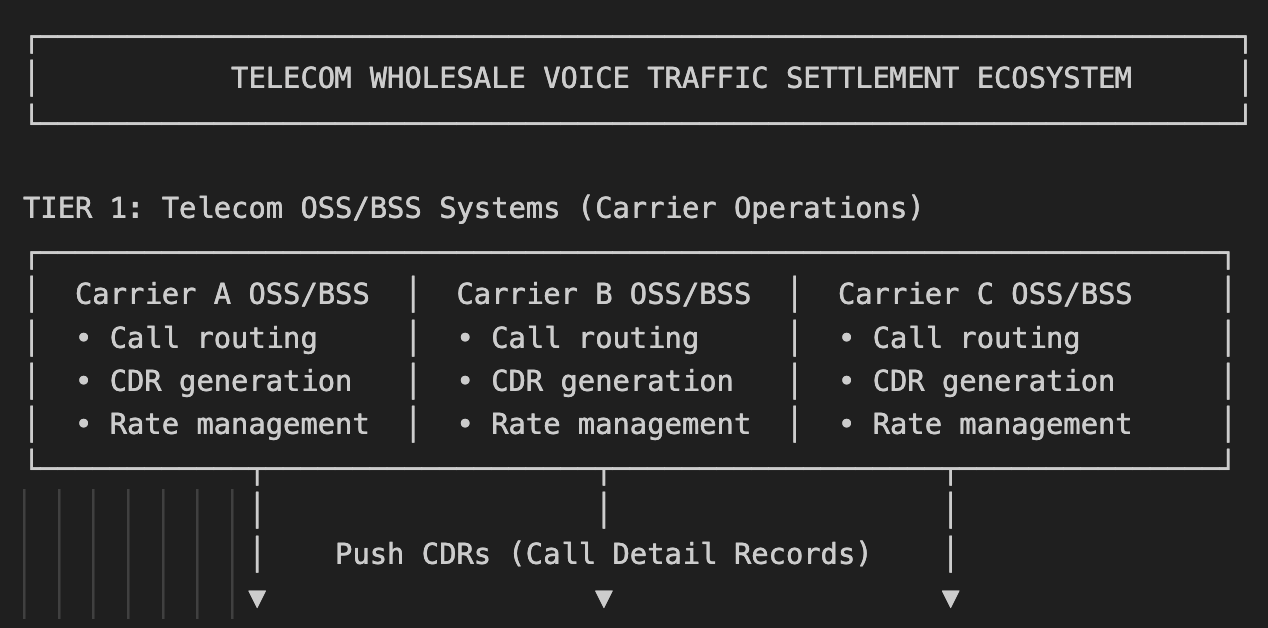
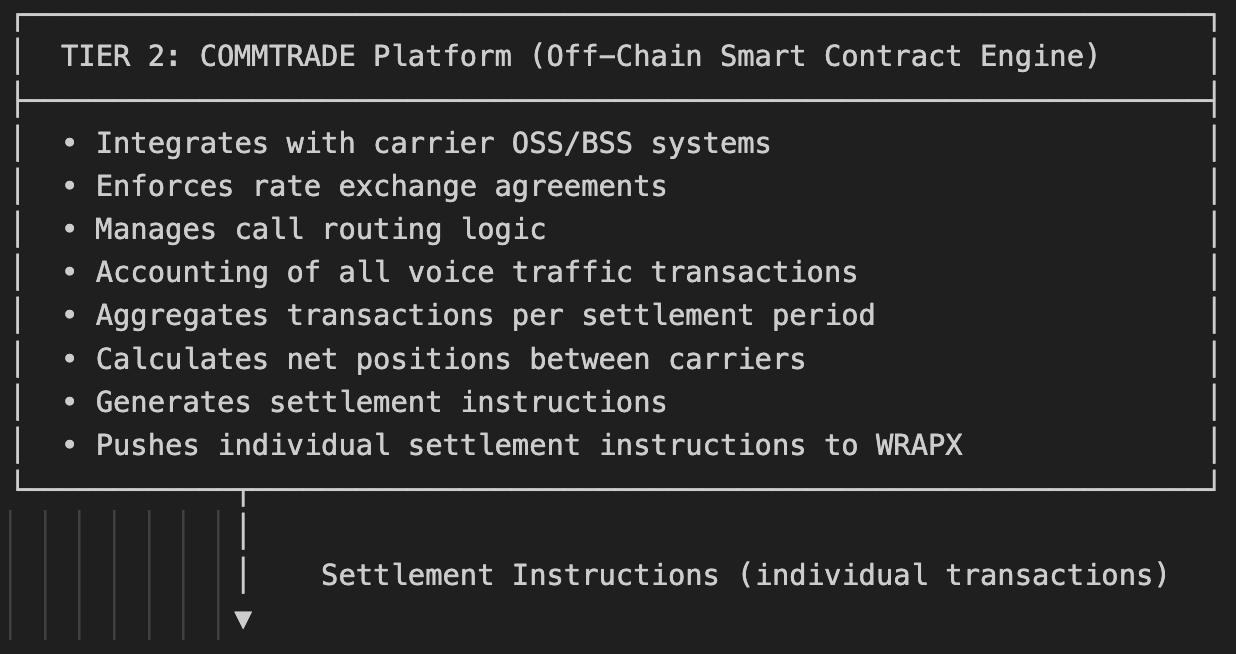
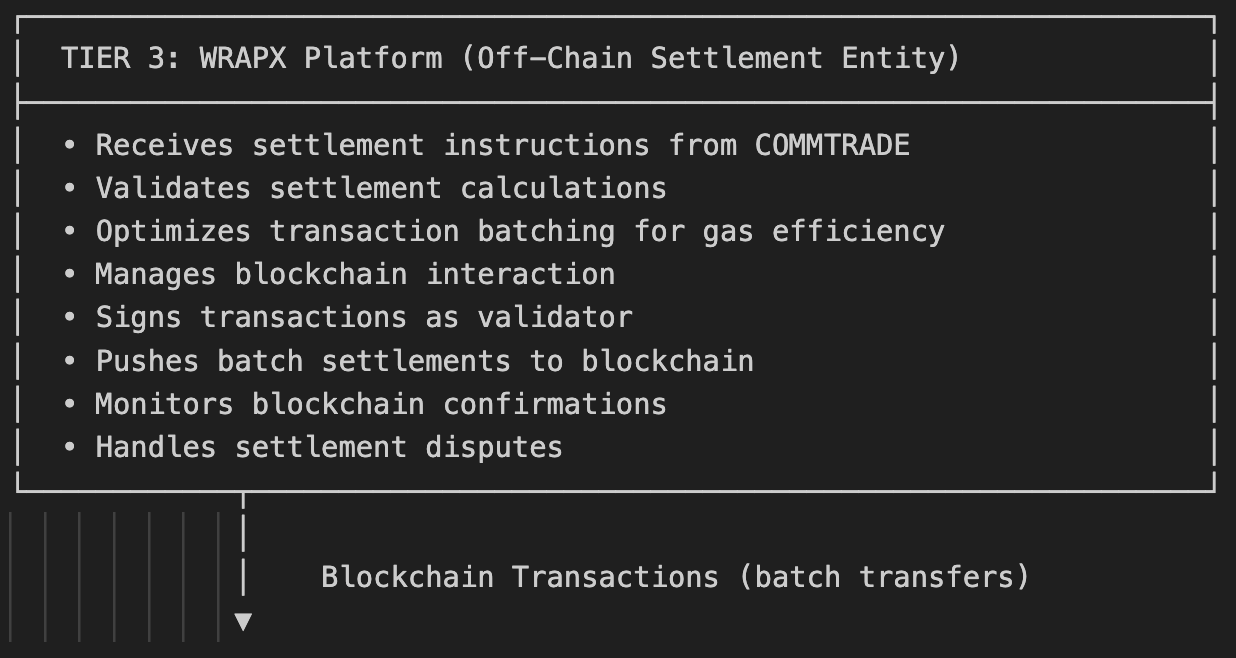
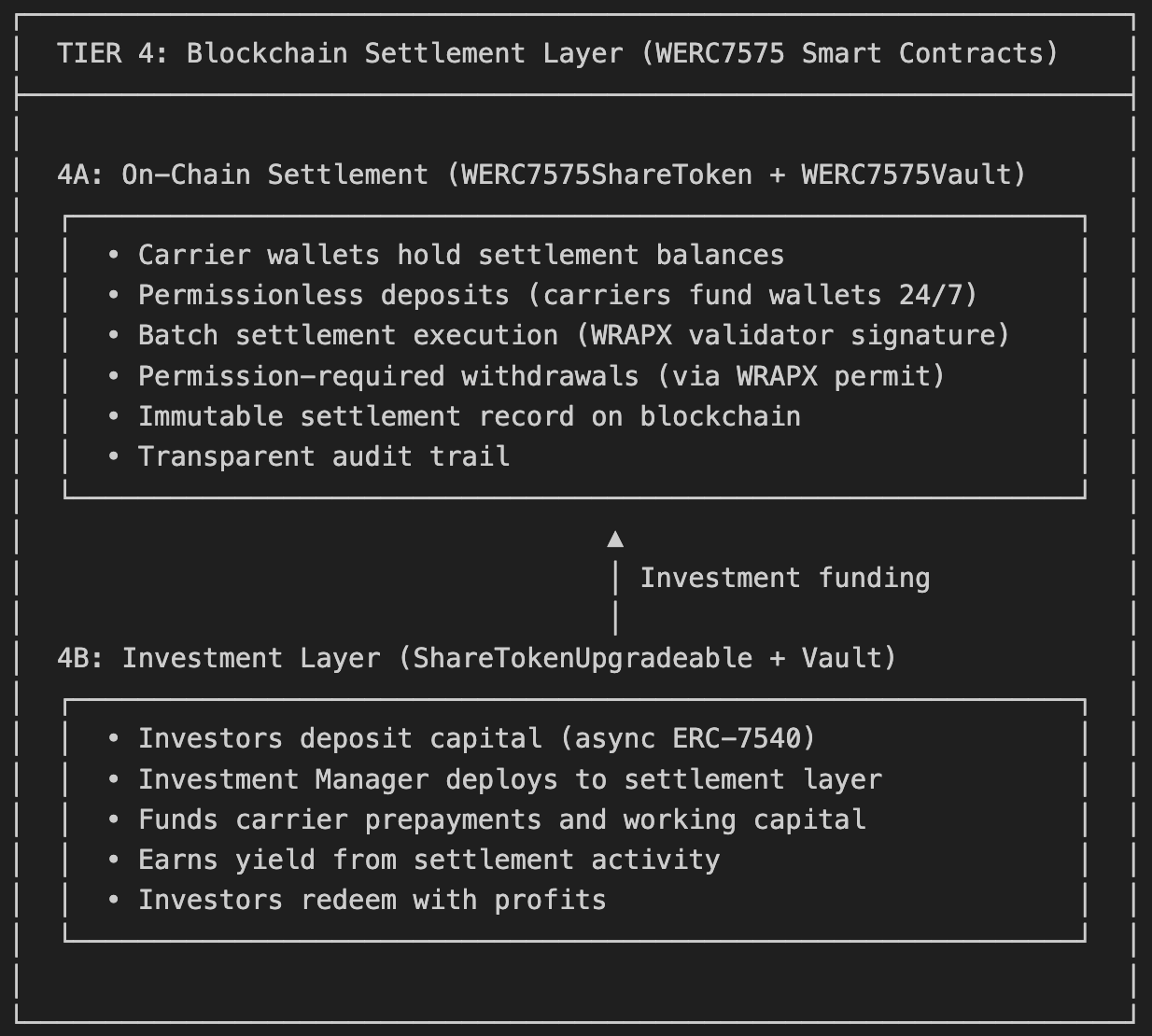
Layer by Layer Breakdown
TIER 1: Telecom OSS/BSS Systems
Components: Carrier operational systems (legacy telecom infrastructure)
Responsibilities:
- Call Routing: Direct voice traffic between carriers
- CDR Generation: Create Call Detail Records for every call
- Origin/destination numbers
- Call duration
- Timestamps
- Quality metrics
- Rate Management: Apply agreed rates per destination/carrier
- Real-Time Operations: 24/7 voice traffic handling
Output: CDRs (Call Detail Records) pushed to COMMTRADE
Example:
Carrier A routes call: +1-555-0100 → +44-20-7946-0958
Duration: 15 minutes
Rate: $0.02/minute
Cost: $0.30
CDR sent to COMMTRADE for accounting
TIER 2: COMMTRADE Platform (Off-Chain Smart Contract Engine)
Nature: Off-chain platform with smart contract capabilities
Responsibilities:
1. OSS/BSS Integration
- Connects to multiple carrier OSS/BSS systems
- Ingests CDRs in real-time
- Normalizes data formats across carriers
2. Rate Exchange Management
- Enforces bilateral rate agreements
- Applies volume discounts
- Handles rate updates
- Manages currency conversions
3. Call Routing Logic
- Least cost routing (LCR)
- Quality-based routing
- Load balancing
- Failover management
4. Transaction Accounting
- Records every voice traffic transaction
- Applies agreed rates
- Calculates per-carrier balances
- Maintains detailed transaction history
5. Settlement Preparation
- Settlements are accounted for in quasi-real-time and pushed when they reached a defined amount or timer
- Generates settlement instructions
6. Data Push to WRAPX
- Pushes individual settlement instructions (not batched)
- WRAPX receives individual transactions for batching and blockchain execution
- Provides transaction details for WRAPX validation and optimization
Example Settlement Period:
Week 1 Transactions (aggregated by COMMTRADE):
─────────────────────────────────────────────────
Carrier A → Carrier B: 1,000,000 minutes @ $0.02 = $20,000
Carrier B → Carrier C: 800,000 minutes @ $0.025 = $20,000
Carrier C → Carrier A: 500,000 minutes @ $0.03 = $15,000
Carrier A → Carrier C: 300,000 minutes @ $0.028 = $8,400
Carrier B → Carrier A: 600,000 minutes @ $0.022 = $13,200

COMMTRADE calculates net positions:
────────────────────────────────────
Carrier A: -$20,000 - $8,400 + $15,000 + $13,200 = -$200 (net payer)
Carrier B: +$20,000 - $20,000 - $13,200 = -$13,200 (net payer)
Carrier C: +$20,000 - $15,000 + $8,400 = +$13,400 (net receiver)

Individual settlement instructions sent to WRAPX:
──────────────────────────────────────────────────
Transaction 1: Transfer $200 from Carrier A to Carrier C
Transaction 2: Transfer $13,200 from Carrier B to Carrier C

(WRAPX will batch these into a single blockchain transaction)
TIER 3: WRAPX Platform (Off-Chain Settlement Entity)
Nature: Off-chain settlement management platform
Responsibilities:
1. Settlement Validation
- Receives settlement instructions from COMMTRADE
- Validates settlement calculations
- Checks for discrepancies
- Confirms carrier balances sufficient
2. Batch Optimization
- Receives individual settlement instructions from COMMTRADE
- Aggregates multiple instructions into optimized batches
- Optimizes for gas efficiency
- Groups similar operations
- Schedules blockchain transactions
3. Blockchain Interaction
- Acts as validator on WERC7575 contracts
- Signs batch settlement transactions
- Pushes
batchTransfers()to blockchain - Monitors transaction confirmations
- Handles failed transactions
4. Permit Management
- Controls withdrawal permissions
- Issues permit signatures for valid withdrawals
- Enforces withdrawal rules:
- No outstanding settlement disputes
- Regulatory compliance checks
- Sufficient liquidity maintained
- AML/KYC validation
5. Dispute Resolution
- Manages settlement disputes between carriers
- Holds withdrawals during investigations
- Coordinates with COMMTRADE for data verification
- Releases funds when disputes resolved
6. Settlement Monitoring
- Tracks all blockchain settlements
- Generates settlement reports
- Alerts on anomalies
- Maintains audit trail
Example WRAPX Operation:
WRAPX receives individual instructions from COMMTRADE:
────────────────────────────────────────────────────────
Instruction 1: Transfer $500 from Carrier A to Carrier B
Instruction 2: Transfer $300 from Carrier B to Carrier C
Instruction 3: Transfer $400 from Carrier C to Carrier A
Instruction 4: Transfer $200 from Carrier D to Carrier E
... (50 total individual settlement instructions for 20 carriers)

WRAPX batches and optimizes:
────────────────────────────
• Aggregates all 50 individual instructions
• Applies netting algorithm
• Result: 12 net transfers (76% reduction)

WRAPX pushes single batch to blockchain:
──────────────────────────────────────────
batchTransfers(
    debtors:   [Carrier A, Carrier B, ...],
    creditors: [Carrier C, Carrier D, ...],
    amounts:   [200, 13200, ...]
)

Signed by: WRAPX validator private key
Gas cost: ~200k gas (vs. 1M+ gas if each instruction was separate blockchain tx)
TIER 4A: On-Chain Settlement Layer (WERC7575)
Purpose: Telecom Carrier Settlement Platform
Primary Users: Telecom carriers (wholesale voice traffic operators)
Core Function: Real-time settlement of inter-carrier voice traffic transactions
Use Case Flow
┌─────────────────────────────────────────────────────────────────────┐
│                    TELECOM SETTLEMENT FLOW                          │
└─────────────────────────────────────────────────────────────────────┘

Step 1: Carrier Onboarding
──────────────────────────
Carrier A (e.g., Verizon Wholesale) → KYC verification
Carrier B (e.g., AT&T Wholesale)   → KYC verification
Carrier C (e.g., T-Mobile Wholesale) → KYC verification

Each carrier gets:
• Wallet address on WERC7575ShareToken
• KYC verification from validator
• Telecom integration deployed (for settlement enforcement)

Step 2: Funding (Permissionless Deposit)
─────────────────────────────────────────
Carrier A deposits: 1,000,000 USDC
Carrier B deposits: 500,000 USDC
Carrier C deposits: 750,000 USDC

Deposits are PERMISSIONLESS (anyone KYC-verified can fund their wallet)
Reason: Carriers need to top up quickly to maintain service

Step 3: Voice Traffic & Settlement
───────────────────────────────────
Throughout the month:
• Carrier A routes 10M minutes through Carrier B's network → owes $500k
• Carrier B routes 8M minutes through Carrier C's network → owes $400k
• Carrier C routes 5M minutes through Carrier A's network → owes $250k

Settlement platform tracks all traffic via telecom integrations

Step 4: Batch Settlement Execution
───────────────────────────────────
Validator (settlement platform) calls:

batchTransfers(
    debtors:   [Carrier A, Carrier B, Carrier C],
    creditors: [Carrier B, Carrier C, Carrier A],
    amounts:   [500000, 400000, 250000]
)

Netting algorithm optimizes:
• Carrier A: -500k + 250k = -250k (net payer)
• Carrier B: +500k - 400k = +100k (net receiver)
• Carrier C: +400k - 250k = +150k (net receiver)

Only 3 state changes instead of complex multi-transfer cascade!

Step 5: Withdrawal (Permission Required)
─────────────────────────────────────────
Carrier B wants to withdraw 100k from their balance:

• Carrier B requests withdrawal from settlement platform (off-chain)
• Settlement platform validates request (e.g., no outstanding payments)
• Settlement platform issues permit signature:
  permit(Carrier B, Carrier B, 100k, deadline, v, r, s)
• Carrier B calls transfer() with permit → withdrawal succeeds

WHY PERMISSION REQUIRED?
• Prevents withdrawal during settlement disputes
• Ensures regulatory compliance (AML checks)
• Allows settlement platform to freeze fraudulent carriers
• Ensures carriers have sufficient liquidity for ongoing settlement obligations
Key Design Rationale: Settlement Layer
1. Permissionless Deposits (with KYC)
// Anyone can deposit IF they're KYC-verified
function deposit(uint256 assets, address receiver) external returns (uint256) {
    // No special permission needed
    // KYC check happens at mint() when shares are created
}
Why?
- Carriers top up wallets around the clock and cannot wait for manual approval
- KYC gates entry, so deposits themselves need no extra permission
- A deployed telecom integration confirms carrier identity
2. Dual Authorization for Withdrawals
A. Direct Transfer (owner withdraws their own funds)
function transfer(address to, uint256 value) public override {
    _spendAllowance(msg.sender, msg.sender, value); // ← Needs self-allowance permit!
    super.transfer(to, value);
}
Why self-allowance required?
- Open disputes must close before a carrier can withdraw
- Fraud investigations require funds to stay locked
- AML checks gate large withdrawals
- Carriers must keep enough liquidity to cover ongoing settlements
- The settlement platform controls withdrawal timing
B. Third-Party Transfer (authorized party withdraws on owner’s behalf)
function transferFrom(address from, address to, uint256 value) public override {
    _spendAllowance(from, from, value);        // ← Platform authorization (self-allowance)
    return super.transferFrom(from, to, value); // ← Owner delegation (caller allowance)
}
Why BOTH allowances required?
The transfer needs dual authorization:
- Self-Allowance (
allowance[from][from]): Platform/validator permission- “Settlement platform permits this carrier to withdraw funds”
- Set by: Validator via permit signature
- Checks: No outstanding settlements, no disputes, compliance verified
- Caller Allowance (
allowance[from][caller]): Owner delegation- “Carrier delegates authority to this third party”
- Set by: Carrier via standard
approve() - Enables: Smart contract automation, authorized operators
Real-World Example:
Carrier A wants to use InvoicePaymentContract to auto-pay suppliers:

Step 1: Request platform permission
→ Carrier A requests withdrawal clearance from WRAPX
→ WRAPX verifies: no disputes, sufficient balance, compliance OK
→ WRAPX issues permit: allowance[CarrierA][CarrierA] = 1M USDC

Step 2: Delegate to smart contract
→ Carrier A: approve(InvoicePaymentContract, 500k USDC)
→ allowance[CarrierA][InvoicePaymentContract] = 500k

Step 3: Automated payment execution
→ InvoicePaymentContract calls: transferFrom(CarrierA, Supplier, 100k)
→ Checks platform authorization: allowance[CarrierA][CarrierA] ≥ 100k ✓
→ Checks owner delegation: allowance[CarrierA][Contract] ≥ 100k ✓
→ Payment succeeds, both allowances reduced by 100k
Benefits:
- The platform blocks unauthorized withdrawals while carriers delegate to trusted third parties
- Smart contracts can participate once the platform approves
- Platform limits and carrier-set limits are independent, so each can be sized separately
3. Batch Settlement Optimization
function batchTransfers(
    address[] calldata debtors,
    address[] calldata creditors,
    uint256[] calldata amounts
) external onlyValidator nonReentrant returns (bool)
Why?
- Gas Efficiency: Thousands of inter-carrier transactions settle each month; batching keeps costs manageable
- Netting: Circular debts (A owes B, B owes C, C owes A) collapse to a single net transfer
- Atomic Settlement: All transfers succeed together or all revert, preventing partial settlement
- Regulatory Audit Trail: One on-chain transaction covers a full settlement period
Example Optimization:
Without netting: 1000 individual transfers = 51M gas
With netting:    200 net transfers = 10M gas
Savings:         80% gas reduction
4. rBalance System for Investment Tracking
// Tracks investment contract's funds: available vs. invested
_balances[investmentContract]  // Available for funding
_rBalances[investmentContract] // Invested in deals (not yet returned)
_balances[investmentContract]- Available for funding_rBalances[investmentContract]- Invested in deals (not yet returned)
Why?
- Investment Tracking: The investment contract deploys capital into telecom deals and needs a separate counter for funds in play
- Yield Distribution: When deals close profitably, the platform adjusts rBalance to record returns
- Liquidity Management: Separates funds available for new deals from capital locked in existing ones
- Regulatory Reporting: Liquid funds and invested capital appear as distinct line items
Note: Carriers do not get rBalance tracking. Only the investment contract (ShareTokenUpgradeable) uses rBalance to track deployed capital and returns.
Example:
Investment contract (ShareTokenUpgradeable) has 1M USDC deposited in settlement layer:
• _balances[investmentContract] = 600k (available for funding new deals)
• _rBalances[investmentContract] = 400k (invested in deals, earning yield)

When deal returns 20% profit:
• adjustrBalance(investmentContract, 400k invested, 480k returned)
• _balances[investmentContract] = 600k (unchanged - still available)
• _rBalances[investmentContract] = 480k (increased from 400k)
• Investment contract earned 80k profit (480k - 400k)
TIER 4B: Investment Layer (Upgradeable)
Purpose: Investment Capital for Telecom Deals
Primary Users: Investors (not telecom carriers)
Core Function: Collect investment capital and deploy it into the settlement contract to fund telecom traffic deals
Use Case Flow
┌─────────────────────────────────────────────────────────────────────┐
│                    INVESTMENT FLOW                                  │
└─────────────────────────────────────────────────────────────────────┘

Step 1: Investor Onboarding
────────────────────────────
Investor deposits USDC → ERC7575VaultUpgradeable

Request → Fulfill → Claim (ERC-7540 async flow)
• Request: Investor transfers USDC to vault
• Fulfill: Investment Manager converts to shares (when ready)
• Claim: Investor receives duPRT shares

Step 2: Investment Deployment
──────────────────────────────
Investment Manager takes vault's idle USDC and invests:

investAssets(amount) → deposits into WERC7575Vault (Settlement Layer)

WERC7575Vault mints settlement position to ShareTokenUpgradeable (internal)

ShareTokenUpgradeable holds settlement backing on behalf of investors

Step 3: Telecom Deal Funding
─────────────────────────────
Investment capital in Settlement Layer used for:
• Funding carrier prepayments
• Working capital for voice traffic deals
• Margin for settlement float
• Emergency liquidity reserves

Step 4: Yield Generation
────────────────────────
Telecom deals generate profit:
• Settlement fees from carriers
• Voice traffic margins
• Discount on prepayments

Settlement platform adjusts rBalance:
adjustrBalance(ShareTokenUpgradeable, invested, returned)

Step 5: Investor Redemption
────────────────────────────
Investor wants to exit:

• Request redemption of duPRT shares
• Investment Manager withdraws from Settlement Layer
• Investor receives USDC + profit
Key Design Rationale: Investment Layer
1. Async Operations (ERC-7540)
// Request → Fulfill → Claim
function requestDeposit(uint256 assets, address controller, address owner)
function fulfillDeposit(address controller, uint256 assets)
function deposit(uint256 assets, address receiver)
Why?
- Capital Efficiency: The Investment Manager batches deposits when suitable deals appear
- Liquidity Management: Instant execution is not required; queuing deposits preserves flexibility
- Risk Management: The Investment Manager can delay fulfillment during high volatility
2. Investment into Settlement Contract
function investAssets(uint256 amount) external returns (uint256 shares) {
    // Deposit into WERC7575Vault (Settlement Layer)
    shares = IERC7575($.investmentVault).deposit(amount, $.shareToken);
}
Why?
- Direct Exposure: Investors earn yield from real telecom settlements, not synthetic products
- Transparent: Capital flows into the operational contract with a clear on-chain record
- Measurable: The settlement position tracks on-chain through the internal layer
- Liquid: The Investment Manager withdraws from settlement when needed, subject to permit approval
3. Upgradeable Architecture
contract ERC7575VaultUpgradeable is UUPSUpgradeable, OwnableUpgradeable
Why?
- Regulatory Adaptation: Investment products change with compliance requirements
- Feature Additions: New investment strategies slot in without redeploying the settlement layer
- Bug Fixes: Patches apply without migrating carrier funds
- Separation of maturity: The settlement layer is battle-tested and stays fixed; the investment layer evolves independently
System Interaction
Two Layers Working Together
Capital Flow
INVESTORS                    INVESTMENT LAYER              SETTLEMENT LAYER              CARRIERS
   │                              │                              │                          │
   │ 1. Deposit USDC              │                              │                          │
   ├─────────────────────────────►│                              │                          │
   │                              │                              │                          │
   │                              │ 2. Invest USDC               │                          │
   │                              ├─────────────────────────────►│                          │
   │                              │                              │                          │
   │                              │    (settlement to            │                          │
   │                              │◄─────ShareToken)             │                          │
   │                              │                              │                          │
   │                              │                              │ 3. Fund telecom deals    │
   │                              │                              ├─────────────────────────►│
   │                              │                              │                          │
   │                              │                              │ 4. Settlements & fees    │
   │                              │                              │◄─────────────────────────┤
   │                              │                              │                          │
   │                              │ 5. Yield generated           │                          │
   │                              │    (rBalance adjustments)    │                          │
   │                              │◄─────────────────────────────┤                          │
   │                              │                              │                          │
   │ 6. Redeem + profit           │                              │                          │
   │◄─────────────────────────────┤                              │                          │
   │                              │                              │                          │
Yield Generation Mechanism
The Settlement Layer earns from four sources:
- Settlement Fees: Carriers pay a fee per settlement
- Voice Traffic Margins: The platform buys and sells voice minutes at a spread
- Prepayment Discount: Carriers prepay for volume and receive a rate discount; the platform captures the margin
- Liquidity Services: Carriers pay a premium for instant settlement
Profit Distribution:
- The settlement platform calculates returns per period
- It calls
adjustrBalance()on ShareTokenUpgradeable’s position - duPRT share price rises to reflect the higher backing
- Investors redeem duPRT for the underlying stablecoins at the new price
Example: End-to-End Flow
Month 1:
────────
• Investor deposits 100k USDC → receives 100k duPRT shares
• Investment Manager invests 100k USDC → Settlement Layer
• Settlement Layer records backing → ShareTokenUpgradeable → investors hold **duPRT**
• Investment used to fund Carrier A's traffic deals

Month 2:
────────
• Settlement activity generates 10k profit
• Settlement platform adjusts: adjustrBalance(ShareToken, 100k, 110k)
• ShareTokenUpgradeable now has 110k value in Settlement Layer
• duPRT share price: 110k / 100k = 1.10 USDC per duPRT

Month 3:
────────
• Investor redeems 100k duPRT shares
• Investment Manager withdraws 110k USDC from Settlement Layer
• Investor receives 110k USDC
• Profit: 10k USDC (10% return)
Why Two Separate Systems?
Separation of Concerns
| Aspect | Settlement Layer | Investment Layer |
|---|---|---|
| Users | Telecom carriers | Investors |
| Purpose | Operational settlement | Capital deployment |
| Deposits | Permissionless (with KYC) | Async (managed) |
| Withdrawals | Permission required | Managed by IM |
| Architecture | Non-upgradeable (stable) | Upgradeable (flexible) |
| Standards | ERC-20, ERC-2612 | ERC-7540, ERC-4626 |
Why Settlement is Non-Upgradeable
Stability is the priority:
- The layer holds millions in carrier funds; any logic change carries outsized risk
- Real-time settlements must not fail
- Carriers build operational systems on top of it and need predictable behavior
- Battle-tested code accumulates safety over time; upgradeability discards that history
- Regulatory approval ties the contract to a specific implementation
Why Investment is Upgradeable
Flexibility matters here:
- Investment products change with markets and regulation
- New yield strategies slot in without touching carrier settlement
- Bugs can be patched without redeploying the settlement layer
- The Investment Manager adapts the product as conditions shift
Centralization Rationale
Settlement Layer Centralization
Why WRAPX (Validator) controls withdrawals:
Real-world scenario:
─────────────────────
Carrier A withdraws 1M USDC
BUT they have 500k outstanding settlement with Carrier B
PROBLEM: Carrier B cannot settle now!

Solution: WRAPX permit system
────────────────────────────────────
Carrier A requests withdrawal → WRAPX checks via COMMTRADE:
  ✓ No outstanding disputes (COMMTRADE confirms)
  ✓ No pending settlements (COMMTRADE confirms)
  ✓ Regulatory compliance (KYC status current)
  ✗ Large withdrawal → manual review

Only after approval → WRAPX issues permit signature → withdrawal succeeds
Why WRAPX (Validator) batches settlements:
Without batching (direct OSS/BSS → blockchain):
───────────────────────────────────────────────
1000 carriers × 100 transactions each = 100,000 individual blockchain transfers
Cost: Prohibitively expensive in gas
Risk: Some transfers fail = inconsistent state
No optimization possible

With multi-tier architecture (OSS/BSS → COMMTRADE → WRAPX → blockchain):
─────────────────────────────────────────────────────────────────────────
TIER 1 (OSS/BSS): Generates CDRs for all voice traffic
TIER 2 (COMMTRADE):
  • Aggregates CDRs
  • Calculates net positions
  • Sends individual settlement instructions to WRAPX
TIER 3 (WRAPX):
  • Receives individual settlement instructions from COMMTRADE
  • Batches multiple instructions together
  • Optimizes with netting algorithm
  • Pushes single atomic batch to blockchain
TIER 4 (Blockchain): Executes batched settlement

Result: 100,000 CDRs → 5,000 settlement instructions → 200 batched blockchain txs
Cost: 95% gas savings
Risk: All-or-nothing = consistent state
Benefit: COMMTRADE handles complex rate logic, WRAPX optimizes blockchain efficiency
Why KYC is required:
Regulatory requirement:
──────────────────────
Telecom settlements = financial services
Multi-jurisdiction carriers = AML compliance
Large transaction volumes = monitoring required
Fraudulent carriers = industry risk

Solution: KYC before wallet creation
────────────────────────────────────
Every carrier verified before COMMTRADE integration
Telecom OSS/BSS integration = identity verification
WRAPX maintains KYC status
Ongoing monitoring via COMMTRADE suspicious activity detection
Why the multi-tier architecture (OSS/BSS → COMMTRADE → WRAPX → Blockchain):
Single-tier approach problems:
──────────────────────────────
❌ Every CDR becomes a blockchain transaction = cost prohibitive
❌ Rate logic on-chain = complex, expensive, hard to update
❌ OSS/BSS systems can't directly interact with blockchain
❌ No optimization layer for gas efficiency
❌ Dispute resolution requires on-chain arbitration

Multi-tier benefits:
────────────────────
✅ TIER 1 (OSS/BSS): Legacy systems work as-is, no blockchain knowledge needed
✅ TIER 2 (COMMTRADE):
   • Complex rate logic off-chain, flexible, updateable
   • Aggregates CDRs and calculates net positions
   • Sends individual settlement instructions (not batches)
✅ TIER 3 (WRAPX):
   • Receives individual instructions from COMMTRADE
   • Batches instructions for blockchain efficiency
   • Gas optimization through netting algorithm
   • Dispute handling and permit management
✅ TIER 4 (Blockchain): Immutable settlement record, transparent, auditable

Cost efficiency:
───────────────
1M CDRs/month → COMMTRADE aggregates and sends instructions →
WRAPX batches into ~ X blockchain tx/day = 30X blockchain txs/month
Without tiers: 1M blockchain txs/month (33,333x/X more expensive!)
Investment Layer Centralization
Why the Investment Manager controls fulfillment:
Capital efficiency scenario:
───────────────────────────
100 investors deposit throughout the month
Each wants immediate shares
BUT only deploy capital when large deal available

Solution: Async fulfillment
───────────────────────────
Investors request deposits (assets secured)
Investment Manager waits for optimal deal
Fulfills all deposits together when deal ready
Capital efficiency: 100% deployed vs. 20% idle
Why the Investment Manager controls timing:
Risk management scenario:
────────────────────────
High volatility period in telecom markets
Investor requests redemption
BUT withdrawing now = selling at loss

Solution: Managed redemption
────────────────────────────
Investment Manager delays fulfillment
Waits for markets to stabilize
Fulfills when profitable exit available
Protects investor returns
Security Considerations
Settlement Layer Security Priorities
Critical Invariants:
- Zero-Sum Settlements: Batch transfers neither create nor destroy value
- Liquidity Protection: Reserved settlement funds cannot be invested
- Withdrawal Safety: The permit system blocks unauthorized exits
- Atomic Settlements: All transfers in a batch succeed together or all revert
Attack Vectors to Consider:
- Manipulating batch netting calculations to extract value
- Withdrawing mid-settlement to force a failure
- Double-spending settlement obligations
- Injecting false rBalance adjustments to fabricate profits
Investment Layer Security Priorities
Critical Invariants:
- Reserved Asset Protection: Pending and claimable funds stay off-limits for investment
- Share Accounting: duPRT is backed by vault assets and settlement positions at all times
- Fulfillment Accuracy: Pending-to-claimable conversions must be exact
- Investment Safety: The contract cannot invest beyond the available balance
Attack Vectors to Consider:
- Inflating the reserved-asset calculation to justify over-investment
- Exploiting the async flow to claim assets twice
- Front-running fulfillment transactions
- Corrupting storage slots during contract upgrades
Integration Notes for Auditors
Understanding Context is Critical
WERC7575 is a settlement platform for commercial counterparties, not a consumer wallet. Restricted withdrawals are not censorship: banks freeze accounts during fraud investigations, escrows hold funds until counterparty release, and clearing houses lock positions through the settlement period. The same logic applies here.
The correct audit questions: Can withdrawal permission be abused to steal funds? Do safeguards exist against a validator blocking legitimate withdrawals?
What Makes This Different from DeFi
| DeFi Standard | WERC7575 Settlement |
|---|---|
| Permissionless access | KYC required (regulatory) |
| Instant withdrawals | Permission required (settlement safety) |
| No operator control | Validator controls (operational necessity) |
| Code is law | Code + legal agreements |
| Trust-minimized | Trust professional operators |
These differences are the business model, not defects.
Conclusion
The WERC7575 system runs two distinct layers:
- Settlement Layer: An operational platform for telecom carrier settlements
- Permissionless deposits, because carriers top up around the clock
- Permission-required withdrawals, to protect settlement integrity
- Batch settlement with netting, for gas efficiency
- Non-upgradeable, for stability under regulatory oversight
- Investment Layer: Capital deployment into settlement operations
- Async deposit and redemption flows, for capital efficiency
- Investment Manager controls timing, to manage risk
- Upgradeable architecture, to adapt to regulatory changes
- Yield sourced from real telecom settlement activity
Both layers are centralized by deliberate design, not by oversight. The business requires settlement control, KYC gating, and managed redemption.
Auditors should focus on: security vulnerabilities within the intended design, business logic correctness, standards compliance, and upgrade safety.
Centralization itself, DeFi comparisons, and philosophical objections are out of scope for a contract audit.
Document Version: 1.0
Last Updated: 2025-01-05
Context: Telecom Wholesale Voice Traffic Settlement + Investment Platform
Use Cases
Introduction
Invoices are the formal records of commercial activity: they document what was sold, when, in what quantity, and at what price, and they establish legally binding payment terms. Businesses track accounts receivable (what customers owe) and accounts payable (what the business owes suppliers) through these records.
Businesses issue invoices in different forms depending on the transaction: standard, commercial, proforma, recurring, or VAT. All require a unique invoice number, dates, pricing, taxes, and payment terms. Businesses use invoices to accelerate collections, reconcile sales, and resolve disputes.
Traditional invoice finance gives businesses working capital before customers pay. A lender advances 80-90% of an invoice, collects payment later, and returns the balance minus fees. Lenders structure this as invoice factoring, where the lender collects, or invoice discounting, where the business collects.
Use Case 1 Postpaid Funding for Telecom Carrier Voice Traffic Use Case 2 Postpaid Funding for Application 2 Phone (A2P) Messaging (SMS) Traffic Use Case 3 Prepayment Funding for SMS Firewall & Exclusive Termination Deals Use Case 4 Prepayment Funding for Special Rate Carrier Voice Termination Use Case 5 Funding Wireless POTS Deployments in the USA Use Case 6 Import/Export Finance for Commodities & Goods Use Case 7 Real Estate Commission Funding in the UAE Use Case 8 Hardware & Machinery Financing Use Case 9 Merchant Credit Lines for Retail and Services
Use Case 1
Postpaid Funding for Telecom Carrier Voice Traffic
Wholesale telecom carriers form the global backbone for voice traffic. They buy and resell large volumes of call termination, route traffic between networks, and enable VoIP, mobile calling, and unified communications. The industry has shifted to IP-based routing and cloud platforms, with 5G expanding capacity and cutting latency.
Carriers use Least Cost Routing (LCR) to select the cheapest routes in milliseconds from live rate decks, while holding quality thresholds like ASR, ACD, and post-dial delay. Margins are thin, so accurate rate data, quality monitoring, and redundancy determine profitability. Where termination rates or regulatory structures diverge, arbitrage opportunities arise, making transparent routing and audit trails essential.
Billing and settlement run on Call Detail Records (CDRs). CDRs capture call metadata: origin, destination, timestamps, duration, routing, and termination cause. Carriers normalize, rate, and aggregate these records into itemized invoices, then use them for reconciliation, dispute resolution, and revenue assurance across inter-carrier relationships.
Use Case 2
Postpaid Funding for Application 2 Phone (A2P) Messaging (SMS) Traffic
The A2P messaging industry covers automated business-to-consumer communications delivered through SMS, WhatsApp, and RCS: alerts, marketing, one-time passwords, and customer notifications. E-commerce and banking pull growth, as both sectors need secure authentication and real-time engagement. SMS commands the largest share of spend even as OTT platforms gain volume.
Security and compliance (2FA, fraud prevention), platform consolidation among CPaaS leaders like Twilio, Sinch, Infobip, and Route Mobile, and regulatory oversight shape market dynamics. The market runs to multi-billion dollar scale and is projected to exceed $90-125B in the early 2030s, with AI-driven personalization and channel orchestration driving further investment.
Aggregators and carriers use Least Cost Routing (LCR) to select the cheapest compliant paths in real time, balancing cost against delivery quality. Grey routes, which disguise A2P traffic as P2P to cut costs, create blocking, lower delivery rates, and fraud exposure.
Price gaps between premium white routes and lower-cost grey routes create arbitrage. Blended pricing reduces enterprise costs but leaks revenue for mobile network operators, pushing stronger enforcement and a shift toward verified routes and OTT alternatives.
A2P invoicing runs on per-message rating and detailed charging models. CDRs track sender IDs, destination networks, delivery status, message type, and charges, enabling accurate billing, 10DLC compliance fees, and pass-through termination charges. Carriers need rating, routing, and trading platforms to preserve margins across diverse rate decks.
SMS firewalls shape settlement economics by filtering grey traffic and monetizing legitimate A2P delivery. Operators run AI-driven security to detect AIT fraud, enforce sender verification, and bill only authorized traffic.
Mudarabah Principles for Traffic Funding
SukukFi applies a Mudarabah structure to fund postpaid traffic, paying suppliers and distributing profits according to pre-agreed terms:
- Capital deployment: Investment vaults (rab al-mal) provide funds to an operating entity (mudarib) on CommTrade to serve a pre-approved debtor, such as a Tier 1 operator or hyperscaler.
- Vendor payments: CommTrade automates supplier payments for the debtor’s traffic while enforcing profitability thresholds.
- Real-time profit control: CommTrade validates traffic and margins, removing unprofitable routes to protect returns.
- Profit realization: When the debtor pays the invoice, SukukFi collects funds into a fiat account, converts them to stablecoins, and distributes them to the investment vault and the mudarib according to the agreed profit split.
Comparison to Traditional Invoice Finance
| Dimension | Traditional Invoice Finance | SukukFi |
|---|---|---|
| Return mechanism | Interest charged on a loan | Profit sharing, no interest charged |
| Funding target | Advances a percentage of the invoice | Pays the supplier’s cost directly in the transaction chain |
| Security structure | Invoice held as loan collateral | Asset-backed, profit-sharing participation |
- Operational enforcement: CommTrade enforces routing and profitability in real time, cutting leakage and keeping funded traffic profitable.
- Settlement-grade audit trail: CDR-based validation and smart contract controls give transparent, verifiable cash-flow tracking.
Use Case 3
Prepayment Funding for SMS Firewall & Exclusive Termination Deals
Mobile network operators use exclusive A2P gateway agreements to secure their networks, cut fraud, and monetize international A2P traffic. Under these arrangements, a single partner manages and terminates all inbound messaging, replacing fragmented multi-aggregator routing.
Exclusive gateways protect revenue by shutting down grey routes, applying anti-fraud tooling, and enforcing high-quality delivery for OTPs and critical notifications. Many agreements cover A2P voice and flash calls alongside SMS, giving operators a single point of control for omnichannel security and compliance.
SMS firewall gateways classify traffic in real time, filter spam and phishing, enforce licensed routes, and produce analytics that support accurate billing. Operators preserve revenues and improve subscriber trust by blocking unauthorized traffic at the gateway level.
SMS firewall deals require the deploying operator to aggregate inbound market traffic, commit to minimum monthly volumes, and prepay for capacity over 6 to 24-month terms.
Use Case 4
Prepayment Funding for Special Rate Carrier Voice Termination
Carrier voice bilateral agreements define direct, negotiated routes for international voice traffic. Carriers set pricing, volumes, SLAs, and term commitments through these contracts, controlling quality and profitability without depending on hubs or transit.
Swap deals and special rate agreements are standard in wholesale voice. Carriers exchange traffic commitments to unlock better rates, then sell excess or discounted termination capacity to downstream customers, typically with prepayment commitments to secure volume and contain risk.
These structures cut costs and let carriers plan margins with confidence, while expanding coverage and holding service quality on high-volume routes.
Murabaha Principles for Prepayment Funding
SukukFi uses Murabaha to fund operating entities purchasing capacity from suppliers at cost plus a pre-agreed, disclosed markup payable over time.
SukukFi covers prepayments for firewall deployments, exclusive gateway capacity, and special-rate termination without interest-based lending.
- Asset-backed structure: Financing ties to telecom capacity, not unsecured cash lending.
- Direct vendor payment: SukukFi pays suppliers to maintain transparency and compliance.
- Known profit margin: SukukFi agrees the markup upfront, with clear repayment terms.
- Receivable security: SukukFi takes security over the operating entities’ debtor receivables and collects debtor payments through its banking infrastructure.
Murabaha vs Traditional Riba Based Finance
| Dimension | Riba-Based Finance | Murabaha (SukukFi) |
|---|---|---|
| Basis | Cash lending at interest | Tied to real assets or capacity |
| Pricing | Interest compounds over time | Profit markup disclosed and agreed upfront |
| Fund flow | Cash disbursed to the borrower | Paid directly to the supplier, confirming delivery |
| Collection basis | Interest schedule | Actual customer payments (receivables) |
- Islamic finance principles: The structure avoids riba and ties returns to real economic activity.
Use Case 5
Funding Wireless POTS Deployments in the USA
Wireless POTS replaces legacy copper landlines with LTE/5G or broadband adapters that deliver analog dial tone to alarm panels, elevator phones, and fax machines. As carriers retire copper networks and service mandates expire, businesses must migrate to remotely managed digital alternatives.
Rising costs for legacy lines, shrinking carrier support, and failover requirements in life-safety and compliance environments push that migration. Wireless POTS deployments require certified hardware purchased and installed at scale, backed by multi-year service contracts.
Murabaha Principles for Funding Wireless POTS Deployments in USA
SukukFi funds these deployments through Murabaha financing tied to the equipment and service contract, with repayments matched to recurring revenue over the contract term.
- Contract-linked funding: SukukFi structures financing around recurring revenue agreements, over 36 months.
- Direct vendor payment: SukukFi pays approved suppliers to procure deployment hardware.
- Known profit margin: Cost plus markup is disclosed upfront with clear repayment terms.
- Receivable security: SukukFi secures the contract receivables and collects customer payments through its banking infrastructure.
Sharia conclusion: The structure is asset-backed and transparent, avoiding riba by tying funding to real economic activity and measurable service delivery.
Comparison to interest-based financing: Loans charge interest on cash advances. Murabaha financing links returns to tangible equipment and disclosed markups, giving operators predictable costs while aligning funding to delivered capacity and contracted cash flows.
Use Case 6
Import/Export Finance for Commodities & Goods
Exporters must fund production, shipping, and customs before any buyer payment arrives. Importers need time to sell inventory after delivery. That working capital gap is what traditional finance addresses with letters of credit, guarantees, or short-term loans.
SukukFi finances the full trade cycle: sourcing goods, paying suppliers, covering freight and insurance, and storing inventory in bonded warehouses until distribution. Both exporters and importers get funding tied to underlying goods and receivables, with repayment schedules they can predict.
How SukukFi Enables End-to-End Trade Finance
- Supplier funding: SukukFi pays producers upfront to secure inventory and manufacturing capacity.
- Trade logistics: SukukFi covers shipping, customs, and insurance to keep goods moving across borders.
- Bonded warehousing: SukukFi stores inventory under customs control, deferring duties and VAT until release.
- Distribution finance: Repayments are collected as the business sells goods to end customers, aligning cash flow to sales.
Shariah-Based Structuring
- Mudarabah: Capital providers fund trade activity while operating partners manage procurement and logistics, sharing profits by agreed ratios.
- Murabaha: SukukFi purchases goods and resells to the business at a disclosed markup, payable over time.
- Musharakah: SukukFi and the business jointly participate in trade inventory, sharing both risk and profit from actual sales.
Sharia conclusion: Funding stays asset-backed and tied to real trade flows, avoiding riba by linking returns to underlying goods, services, and sales performance.
Comparison to Traditional Trade Finance
- Letters of credit: Conventional LCs rely on bank guarantees and interest-bearing credit. SukukFi structures funding through asset-based trade transactions.
- Bank guarantees: Traditional guarantees charge fees for credit risk coverage. SukukFi allocates capital to goods and logistics with transparent profit sharing.
- Working capital loans: Interest-based facilities charge for the time value of money. SukukFi uses Murabaha or Musharakah to tie returns to real trade assets.
- Invoice discounting: Conventional finance advances cash at a discount. SukukFi funds receivables through asset-backed structures with disclosed profit margins.
Use Case 7
Real Estate Commission Funding in the UAE
UAE developers pay broker commissions on off-plan sales in staged payouts that can stretch 90-120 days after booking. Despite strong market volumes and high headline commissions, brokerages and their sales agents carry that cash-flow gap.
SukukFi provides commission factoring to brokerages, advancing cash against confirmed developer receivables. Brokerages can pay sales agents faster and stay competitive for top-performing talent and developer allocations.
Dubai’s off-plan market reached roughly AED 254 billion (USD ~69 billion) in 2024, with off-plan sales dominating transaction volume. A reasonable 2026 outlook for Dubai off-plan activity is AED 300-400 billion (USD ~82-109 billion). At a typical 5% commission, the addressable commission pool runs to roughly AED 15-20 billion (USD ~4.1-5.4 billion) annually for off-plan sales alone.
Mudarabah: Capital providers fund commission advances while brokers manage sales execution, sharing profits by agreed ratios. Returns tie to realized commissions and collections, keeping the structure asset-backed and aligned with actual sales activity.
Faster commission payouts let brokerages attract and retain top sales agents, pay ahead of peers, and secure better developer allocations. That talent concentration improves conversion rates and strengthens access to the best off-plan deal flow, compounding broker performance over time.
Traditional invoice factoring relies on interest-based discounting and faces limited appetite from Western financiers reluctant to underwrite UAE and GCC developer receivables due to jurisdictional risk perceptions. Mudarabah provides risk-sharing capital aligned with commissions actually earned, without charging interest on short-term advances.
Use Case 8
Hardware & Machinery Financing
SukukFi finances equipment across telecom, retail, logistics, and technology by funding asset acquisition or leasing and tying repayments to operating revenues. Businesses get asset-heavy growth without large upfront capital outlays.
Murabaha: SukukFi acquires equipment, handsets, POS terminals, servers, or machinery, and sells it to the customer at a disclosed markup with deferred payments, aligning cash flow to revenue collection.
Ijara: SukukFi retains ownership and leases the asset to the customer at a fixed rental, with optional transfer of ownership at term end. This suits fast-depreciating technology or assets that need periodic upgrades.
Breadth of Opportunity
- Telecom handset financing: The mobile operator serves as debtor, with repayments drawn from subscriber airtime and device plans.
- POS systems for merchants: SukukFi finances terminals and software with repayments linked to card-present transaction revenue.
- AI and cloud infrastructure: Tech companies finance bare-metal servers, GPU clusters, or networking gear and repay from service revenues.
- Industrial machinery: SukukFi funds manufacturing equipment, CNC machines, and processing lines with repayments tied to production output.
- Logistics assets: Warehousing automation, forklifts, and fleet equipment are financed and repaid from distribution revenues.
Sharia conclusion: Murabaha and Ijara keep returns asset-backed and transparent, linking profit to real equipment usage and customer revenues rather than interest on cash lending.
Use Case 9
Merchant Credit Lines for Retail and Services
Traditional merchant cash advances (MCAs) give merchants fast liquidity by taking a fixed share of daily card receipts, but price that liquidity like interest. SukukFi replaces MCA-style facilities with Sharia structures that fund real inventory and working capital without interest-based lending.
A grocery retailer, for example, uses a SukukFi credit line to pay wholesalers for inventory. Repayments come from point-of-sale (POS) revenues as goods sell, matching cash outflows to business performance.
Sharia Structuring
- Murabaha: SukukFi purchases inventory or goods from suppliers and sells them to the merchant at a disclosed markup, payable over time. Financing stays asset-backed and tied to real trade flows.
- Mudarabah: SukukFi provides capital into the trading activity, paying suppliers on behalf of the merchant. The merchant manages procurement and sales, and profits are shared by agreed ratios linked to actual sales performance.
Use Cases Across Merchant Segments
- Grocery and retail: SukukFi finances inventory purchases with repayments from POS receipts.
- Restaurants and cafes: SukukFi provides working capital for food suppliers and payroll, repaid from daily card sales.
- Pharmacies and medical suppliers: SukukFi funds stock replenishment in line with sales velocity.
- Services and salons: Equipment and consumables are financed with revenue-linked repayments.
Sharia conclusion: Murabaha and Mudarabah tie returns to real goods and business performance, giving merchants a transparent alternative to MCA products with flexible, revenue-aligned repayment schedules.
Risk Management
Business Risk Assessment Investor Protection
Business Risk Assessment
SukukFi assesses each financing arrangement before a pool opens and monitors it throughout the credit cycle. Assessment focuses on transaction quality rather than operational history alone.
Credit assessment
SukukFi evaluates borrower creditworthiness using telecom industry expertise and knowledge of the specific counterparties involved. For telecom wholesale financing, the key question is whether the buyers, such as Tier 1 operators, hyperscalers, and government departments, have the credit quality and payment track record to settle invoices reliably.
Transaction-level verification
CommTrade checks each transaction for commercial viability before settlement. On-chain settlement records land on Berachain via the WrapX layer, creating an immutable audit trail for every funded invoice. This transaction-level visibility matters in telecom, where settlement volume is high and reconciliation is operationally complex.
Payment processor assessment
SukukFi uses a regulated payment processor to collect obligor fiat invoice receipts and convert them to stablecoins for vault repayment. The processor is FINTRAC-registered and holds a Bank of Canada Payment Service Provider registration. LP capital sits in on-chain vault contracts and is not held or custodied by the processor at any point. Processor exposure is operational in nature: the question is whether fiat collections can be received and converted on schedule, not whether LP principal is safe with the processor.
SukukFi’s assessment of this risk considers: the processor’s regulatory standing; the contractual protections in the services agreement (segregated customer accounts, defined settlement windows, freeze notification obligations, and termination rights on insolvency); the processor’s role as a pipeline rather than a custodian; and SukukFi’s operational capacity to substitute processors within the contractual notice period. This risk is disclosed as medium in each vault’s risk tab. Specific contractual terms are subject to execution of the final services agreement.
Capital provider responsibility
Each pool’s documentation (see PrimeTel Vault for the live example) provides the risk assessment for that specific borrower and structure. You make the final allocation decision based on that information.
Investor Protection
For live pool risk disclosures, see PrimeTel Vault. Protocol metrics are defined in Protocol Statistics.
Transaction-backed financing
Capital deploys into verified trade flows: real invoices with identified buyers. The CommTrade platform validates each transaction before settlement. On-chain records on Berachain provide an immutable audit trail you can verify independently.
Ongoing monitoring
CommTrade tracks business operations and settlement activity throughout the financing period. Payment anomalies flag before they escalate.
No credit insurance
SukukFi does not provide credit insurance. Under Mudarabah and Murabaha structures, capital providers bear the credit risk of the underlying trade. This is a requirement of Islamic finance principles: conventional insurance on profit-sharing arrangements is impermissible. The trade-off is that returns reflect actual risk, not a guaranteed yield net of hidden insurance costs.
Smart contract audits
Vault contracts on Berachain are audited. Reports are at Security Audits.
Liquidity & Redemption
Withdrawal Process Secondary Market Liquidity
Withdrawal Process
Investment vaults use ERC-7540 asynchronous redemptions: Request → Fulfill → Claim.
When liquidity is available in the vault
If stablecoins are idle and not deployed, the Investment Manager can fulfill redemption requests sooner after processing the batch.
When capital is deployed
If capital is active in the credit line, redemptions queue until liquidity returns from business repayments or new deposits. For PrimeTel, timing ties to invoice cycles. See PrimeTel Vault.
Steps
- Submit a redeem request with your duPRT shares
- The Investment Manager fulfills when liquidity allows
- Claim stablecoins to your wallet
Secondary exit
A duPRT market on Kodiak is planned but not yet live; no pool exists today, so there is currently no secondary exit. See Secondary Market Liquidity.
Step-by-step: How to Redeem & Withdraw.
Settlement-layer withdrawals on CommTrade use a separate permissioned model. See Centralization Rationale.
Secondary Market Liquidity
duPRT is a standard ERC-20 token, so a secondary market on the Kodiak AMM is possible in principle. No duPRT pool exists on Kodiak today, because the duPRT float is not yet large enough to seed one, so there is currently no secondary exit. This page describes how it will work once a pool is created.
How secondary exit works
- Go to Kodiak Finance on Berachain and find the duPRT trading pair (once a pool has been created).
- Sell your duPRT for the paired stablecoin.
- Stablecoins arrive in your wallet immediately, subject to available liquidity and slippage.
Considerations
- Slippage: a Kodiak pool would likely have limited depth, particularly for large positions. Check the price impact before executing.
- Market price vs NAV: a Kodiak price would reflect supply and demand and could sit at a discount or premium to the vault’s net asset value.
- LP opportunities: once a pool exists you will be able to provide liquidity to it on Kodiak and earn trading fees. This adds AMM impermanent loss risk on top of the underlying pool risk.
For the primary redemption path through the vault, see Withdrawal Process and How to Redeem & Withdraw.
Platform Fees
Fee Structure
Performance Fees: SukukFi takes up to 20% of profit distributed to investors. SukukFi may waive this fee for specific pools, campaigns, or periods. Pool documentation and the app display each pool’s fee treatment at deposit. PrimeTel currently runs with the performance fee waived.
Settlement Fees: SukukFi charges businesses 0.15% on CommTrade when settling payments with suppliers.
Telecom Transaction Fees: $0.00015 per voice, SMS, or data transaction on CommTrade (business-side).
No Management Fees: SukukFi charges investors no ongoing management fees.
No Withdrawal Fees: SukukFi charges investors no withdrawal fees on the investment vault layer.
Referral Reward
SukukFi sets aside 5% of the protocol fee pool for the Referral Reward: a monthly stablecoin payout to referrers who referred eligible depositors. SukukFi distributes this proportionally by referred deployed capital. It does not affect investor returns. See Invite Code for full details.
Referral Programme
Share your referral link. If someone arrives through it and deploys capital for 30 days or more, SukukFi pays you a monthly referral reward in a stablecoin, out of its own platform fees. The CommissionRegistry contract on Berachain mainnet records code registration, wallet linking and deployment tracking on-chain, so attribution and eligibility are publicly verifiable. Payment itself is made by the operator and is not executed by the contract.
What the programme is, and what it is not
It is a referral link and nothing more. You register a code, you share a URL, and that is the whole of your role. The person who follows your link reads the terms, makes their own decision, connects their own wallet and transacts directly with SukukFi. You never see their money, never hold it, never touch their wallet, and have no part in the transaction.
The reward comes out of SukukFi’s own revenue, not out of anyone’s capital. You receive no part of the referred participant’s deposit and no share of their return. The reward pool is a fixed percentage of the platform fees SukukFi collects from CommTrade participants. If SukukFi earns nothing, the pool is nothing.
Read the Programme Rules before you share your link. They set out what you may and may not do. They are conditions of the programme, not guidance, and breaking them ends your participation.
The Referral Reward
- Rate: 5% of the protocol-wide fee pool per distribution period
- Weighting: Proportional to referred deployed capital versus total deployed capital across all vaults
- Start condition: 30 days of continuous deployment (no cliff)
- Stop condition: The reward stops when the referred LP exits a vault
- Payment currency: A stablecoin (USDC.e on Berachain). Protocol fees are collected in trUST from CommTrade participants and converted by SukukFi before payout, so referrers never hold trUST.
- Frequency: Monthly
The pool is protocol-wide, not per-vault. Referrers earn proportionally to referred deployed capital across all vaults, so pushing LPs toward any particular pool offers no advantage.
Reward Calculation
Each month:
- The protocol collects fees from vault activity across all active pools
- 5% of those fees form the Referral Reward pool
- Each referrer’s share equals: eligible capital they referred / total eligible deployed capital across the protocol
- SukukFi converts the corresponding amount of collected fees to a stablecoin and the operator transfers it to each referrer’s wallet
Example:
- Total eligible deployed capital: $2,000,000
- Capital you referred (all eligible): $200,000
- Your pool weight: 10%
- Total protocol fees this month: $80,000
- Referrer pool (5%): $4,000
- Your referral reward: $400, paid in stablecoin
Capital deployed fewer than 30 days does not count in a given distribution. Capital deployed on day 28 counts in the next month’s calculation.
Paid in Stablecoin
The reward is paid in a stablecoin, directly to your wallet. Nothing needs redeeming and no approval is required to convert it.
SukukFi collects protocol fees from CommTrade participants in trUST and converts them before payout. Referrers do not receive or hold trUST. trUST is confined to CommTrade participants settling wholesale telecom traffic between themselves, and paying rewards in it would put it outside that set.
What controls the programme. Two things, both verifiable on-chain: the 30-day continuous deployment minimum before capital counts, and the pool-weighted calculation, which is derived from deployment data recorded by the contract rather than from a figure SukukFi asserts. Payment timing is operator-controlled and monthly. The programme is not trustless: attribution and eligibility are on-chain, the payment is not.
The 30-Day Minimum
A 6-month cliff would mean earning nothing for half a year while your referred LP’s capital generates protocol revenue from day one. That gap makes referring economically irrational.
30 days works differently. Capital deployed for one full month counts in the next distribution. The reward accrues from month 2 onward for as long as the LP stays deployed. No cliff, no ramp, no vesting.
The window is long enough to rule out flash deposits. LP capital in ERC-7540 async vaults is naturally sticky: 15-day invoice settlement cycles make early withdrawal rare. 30 days confirms real deployment without penalising referrers with a long wait.
When an LP withdraws, their contribution drops to zero in the next pool weight calculation and the reward stops. No clawback. The stop is automatic.
Programme Rules
These are conditions of taking part. If you do not accept them, do not share your link.
What you may do
Generate a referral code and share your referral link.
That is the entire permitted activity. The link may be shared publicly or privately, and you may say that you use SukukFi yourself.
What you must not do
You must not:
- Advise anyone on whether to deposit, how much to deposit, or which vault to use.
- Recommend that any particular person deposit, or suggest that a deposit is suitable for them.
- Discuss or negotiate terms. The terms are what SukukFi publishes. You have no authority to vary, interpret or supplement them.
- Accept, hold, transmit or handle any person’s money, stablecoin, wallet, private keys or deposit instruction, at any time, for any reason.
- Complete onboarding, connect a wallet or submit a deposit on anyone else’s behalf.
- Hold yourself out as acting for SukukFi, or as an agent, adviser, broker, intermediary, distributor or representative of SukukFi. You are not any of those things.
- Publish any statement about returns, yields, targets, projections or performance alongside your link, or in any communication that carries it. That includes the figures published on SukukFi’s own pages. Link to them; do not repeat them.
- Make any claim about SukukFi that does not appear on SukukFi’s own published materials.
- Share your link with any person in the United Kingdom, or in any jurisdiction listed under Access & Compliance.
Approved wording
If you want something to say, use this and nothing more:
I use SukukFi. If you want to look at it yourself, here is my referral link: [link]
Anything beyond that is your own communication and your own responsibility, and it may breach these rules.
Who may take part
You must not take part if you are resident in, or a national of, the United Kingdom or any jurisdiction listed under Access & Compliance.
If you break these rules
SukukFi may withhold accrued rewards, deregister your code and exclude you from the programme. Attribution already recorded on-chain cannot be deleted, but payment is operator-made and can be stopped.
Why the programme is built this way
A referral link that a person follows of their own accord, to a platform they then deal with directly, is a different thing from someone bringing about an investment on another person’s behalf. The rules exist to keep it the first thing. The reward being a share of SukukFi’s platform fees rather than of anyone’s capital or returns is part of the same design.
How the Referral Link Works
Each referrer gets a unique bytes32 code derived from their wallet address:
code = keccak256(abi.encodePacked(referrerAddress, 0))
No server generates this and no database stores it. The same address always produces the same code. Any party can verify a code’s origin on-chain by checking whether keccak256(abi.encodePacked(claimedAddress, 0)) matches the registered code.
Codes are first-come, first-served. One address, one code. The registry maps both directions: code to referrer and referrer to code.
A referral link takes the form:
https://app.sukuk.fi/?ref=0xYOUR_CODE_HEX#vault
When an LP clicks your link, the app saves the code. At deposit time, the app calls linkLP(code) on-chain. That link is permanent and cannot be updated.
Step-by-Step Flow
For Referrers
- Register. Navigate to Invite Code in the app, connect your wallet, and click Register a Referral Code. One transaction:
registerCode(bytes32 code), where the code derives from your address. Once confirmed, your code is live. - Share your referral link. The app shows a shareable URL:
app.sukuk.fi/?ref=0x...#vault. Share it. - LP deposits via your link. When the LP deposits, the app calls
linkLP(yourCode)on their behalf. Your code is linked to their wallet on-chain. - Deployment gets recorded. The SukukFi operator calls
recordDeployment(lpAddress)once the LP’s capital is active in a vault. This starts the 30-day clock. Your dashboard shows a countdown per referred LP. - The reward is paid monthly. After 30 days of deployment, the LP counts in the next pool weight calculation. SukukFi converts the corresponding fees to a stablecoin and the operator transfers it to your wallet.
For LPs Being Referred
Referred LPs do nothing differently. Arriving via a referral link, the app calls linkLP() at deposit time, in the same transaction flow as the deposit. No extra step, no additional gas.
An LP links once. Re-depositing later via a different link or without one leaves the original link in place. LPs cannot change their referrer after the first deposit.
LPs who deposit without a referral link have no referrer on their wallet. Their capital contributes to no one’s pool weight.
The Referral Dashboard
The Invite Code view in the app shows three states:
Not connected: Prompt to connect wallet.
Connected, not registered: Three steps to onboard:
- Connect your wallet (done)
- Register as an referrer by sending
registerCode() - Share your referral link
Connected and registered: Your referrer dashboard showing:
- Your Code: the bytes32 hex value registered to your address
- Your Referral Link: the shareable URL
- Referred LPs: count of wallets linked to your code
- Total Paid: cumulative referral reward paid to you across all distributions
- Days Until Eligible: countdown for the nearest LP approaching 30 days
Smart Contract Reference
A note on the on-chain names. The deployed contract is called
CommissionRegistryand several of its functions use the word introducer. Those are immutable identifiers from an earlier version of this programme and cannot be renamed without redeploying. They mean nothing more than “the wallet that registered the referral code”. The programme is a referral programme and the Programme Rules govern it.
| Contract | CommissionRegistry |
| Address | 0x0eEF48743f52Ce317222692DB03143D53C4257ac |
| Network | Berachain mainnet (chainId 80094) |
| Deployment tx | 0x452bc1653b440602803c68b2cc5194c1711f56226ed6f0f8fb5b5828f856e9b9 |
| Payment token in the deployed contract | trUST (0xdaB8586b5126b7B1FCA5611543905597c9910670), set as an immutable at construction. This function is not used. See Distribution Mechanics below. |
| Minimum deployment | 30 days |
| Standard | Non-upgradeable Solidity ^0.8.24 |
Key Functions
| Function | Caller | Description |
|---|---|---|
registerCode(bytes32 code) | Referrer | Registers the caller as an referrer with the given code. Code must equal keccak256(abi.encodePacked(msg.sender, 0)). Reverts if the address already has a code or the code is already taken. |
linkLP(bytes32 code) | LP (at deposit) | Links the caller’s wallet to the referrer who owns code. Can only be called once per LP address. Reverts if LP is already linked or code is unregistered. |
recordDeployment(address lp) | Admin / Keeper | Records the timestamp at which the LP’s capital was deployed into a vault. Starts the 30-day eligibility clock. Can only be called by the protocol operator. |
recordDeployments(address[] lps) | Admin / Keeper | Batch version of recordDeployment. Processes multiple LPs in one transaction. |
isEligible(address lp) | View (anyone) | Returns true if the LP’s capital has been deployed for 30 or more days. |
daysUntilEligible(address lp) | View (anyone) | Returns the number of days remaining until the LP becomes eligible. Returns type(uint256).max if deployment has not been recorded yet. |
distribute(address[] introducers, uint256[] amounts) | Admin | Transfers trUST from the contract to each referrer address and updates totalPaid. Not used. The reward is paid in a stablecoin instead, so this function is not called and the contract holds no trUST. |
getIntroducer(address lp) | View (anyone) | Returns the referrer address associated with a given LP wallet, or address(0) if unlinked. |
codeOf(address introducer) | View (anyone) | Returns the bytes32 code registered to a referrer address, or bytes32(0) if not registered. |
lpCode(address lp) | View (anyone) | Returns the code the LP linked at deposit time, or bytes32(0) if unlinked. |
totalPaid(address introducer) | View (anyone) | Cumulative amount recorded by distribute(). Reads zero while distribute() is unused. |
introducerOf(bytes32 code) | View (anyone) | Reverse lookup: returns the referrer address that registered a given code. |
Distribution Mechanics
Eligibility and attribution are on-chain. Payment is not.
At month end the protocol operator:
- Identifies all LPs with a recorded deployment timestamp 30+ days old (
isEligible()) - Queries each LP’s linked referrer via
getIntroducer() - Calculates each referrer’s pool weight: eligible referred capital / total eligible deployed capital
- Applies the 5% fee pool to compute each referrer’s referral reward
- Converts the corresponding fees, collected in trUST, to a stablecoin and transfers it to each qualifying referrer
Why payment is not made by the contract. CommissionRegistry was deployed with trUST as an immutable payment token. trUST is confined to CommTrade participants settling wholesale telecom traffic between themselves, and paying referral reward in it would place it in wallets outside that set. Referral reward is therefore paid in a stablecoin, which the contract cannot do. The contract will be redeployed with a stablecoin payment token, at which point payment returns on-chain and totalPaid becomes meaningful again.
What this means for you. Steps 1 to 3 are publicly verifiable from the contract: anyone can check which LPs are linked to which referrer and when each became eligible. Step 5 is a transfer the operator makes, visible on-chain as an ordinary stablecoin transfer but not enforced by the contract.
Frequently Asked Questions
Can I have multiple codes?
No. One address, one code. Register a second wallet if you need a separate code.
Can an LP change their referral link after depositing?
No. The link sets on the first deposit and cannot be changed. This prevents switching referrers after capital is already deployed.
What happens if my referred LP withdraws and re-deposits?
Withdrawal ends the deployment record and removes the LP from pool weight calculations. Re-depositing lets the operator call recordDeployment() again, restarting the 30-day clock. The original referrer link persists across the withdrawal and re-deposit.
Is there a minimum deposit size to qualify?
None at the CommissionRegistry level. Any LP with a recorded deployment contributes to pool weight, regardless of deposit size.
When exactly does the 30-day clock start?
When the operator calls recordDeployment(lpAddress), not at deposit time. A short lag exists between an LP’s ERC-7540 async deposit completing and the operator confirming deployment on-chain.
How do I know my referred LPs have been recorded?
Your referrer dashboard shows a countdown per referred LP. You can also call daysUntilEligible(lpAddress) on the contract directly; type(uint256).max means no deployment has been recorded yet.
Can I use my invite code to supplement my own yield?
Yes, with two wallets. Register an invite code on a second wallet, then deposit from your primary wallet using that second wallet’s referral link. Your primary wallet earns LP yield on its deployed capital; your second wallet earns referral reward on that same capital from the 5% referrer pool. That is additive yield, not a redirect of it. Single-wallet self-referral does not work the same way: referral reward on your own deposit from the same address is yield you were already receiving as an LP.
Is the code registered to my address or my ENS name?
Your raw EVM address. ENS names resolve to that address, and the contract uses the resolved value.
Smart Contracts (Berachain Mainnet)
Interact only with the proxy addresses below. Do not call internal implementation or WERC settlement contracts.
Network: Berachain Mainnet · Chain ID 80094 · Explorer: https://berascan.com
Share token
| Symbol | Decimals | Address |
|---|---|---|
| duPRT | 18 | 0xf5Bac52e31317dE901edc773fbef8f75c798f36f |
Vault proxies
Berascan has verified the contract ABI at each address above.
trUST
| Contract | Decimals | Address |
|---|---|---|
| trUST token | 18 | 0xdaB8586b5126b7B1FCA5611543905597c9910670 |
| Settlement vault, USDC.e | 6 | 0x23953876A0f7c367B0Ae5E8b9cFb6b42E503F09b |
| Settlement vault, USD₮0 | 6 | 0x3ddECA146B3179367cC1d782889f938f449c9d21 |
| Settlement vault, HONEY | 18 | 0xC441d4c5F060f96bD7CD20d3D13Ecf957Ea308C7 |
The settlement vaults are the WERC contracts referred to above. Read them freely. Do not transact with them directly. To check that trUST in issue is matched by the backing held in these three vaults, see trUST Backing.
Access control
The contract ABI includes setKYCed(address controller, bool) and isKYCed(address). These functions appear in the repository ABIs but are not present in the deployed mainnet bytecode. Calling isKYCed on either the duPRT vault (0x1B61…) or the duPRT share token (0xf5Ba…) reverts as a nonexistent function, while other functions on the same contracts return correctly: isVaultActive() on the duPRT vault (0x1B61…) returns true, and name() on the duPRT share token (0xf5Ba…) returns duPRT. Each of those getters lives on one of the two contracts and reverts on the other, so test them per contract rather than expecting both from both.
What this means for deposits: A wallet does not need to be whitelisted to call requestDeposit. A requestDeposit from a never-seen address reverts only on ERC20: transfer amount exceeds allowance, the standard token approval check, not on any KYC error. The claim step reverts with InsufficientClaimableAssets() when nothing has been fulfilled, again not a KYC error.
Upgradeability caveat: The vaults are UUPS-upgradeable. The current implementation does not enforce on-chain KYC for LP deposits. A future upgrade could change this. SukukFi will publish notice of any access control change before it takes effect.
Basis: This is empirical (eth_call) evidence against the live contracts on Berachain Mainnet, not source-read. The implementation source is not verified on Berascan. eth_call is reliable for determining whether a given call reverts and on what error, but it is not a substitute for a full source audit.
How TVL is calculated
totalAssets() is not a TVL figure. Per the vault source, totalAssets() deliberately excludes pending deposits, claimable redemptions, cancellations, and any capital already invested. It answers a narrower question: how much is available in this vault right now for a new investment or conversion calculation. Reading it as “how much has been deposited” undercounts the real figure, sometimes down to zero, even when real deposits are sitting in the vault as pending or invested capital.
The complete figure, per vault: take the vault’s raw asset balance (balanceOf of the underlying token at the vault address, equivalent to grossAssetBalance in getVaultMetrics()). This captures every state at once: idle, pending, claimable, and cancelled. It excludes only capital that has already moved elsewhere, which brings us to trUST.
duPRT and trUST do not double count. When the Investment Manager calls investAssets() on a duPRT vault, the underlying asset physically moves into the matching trUST vault for that same asset. duPRT’s own accounting stops counting it (per the exclusion above), and trUST’s totalAssets(), a plain balanceOf with no exclusions, now includes it. So the non-double-counting total across the protocol is: each duPRT vault’s raw balance, plus each trUST vault’s totalAssets(). Every dollar is counted exactly once, wherever it currently sits.
Basis: Confirmed by reading the vault source in sukukfi/security-audits and by direct eth_call against the live vaults, including tracing a duPRT vault’s investment vault to confirm it resolves to trUST’s vault for the same asset. The getter is getInvestmentVault(); a plain investmentVault() reverts.
Protocol Statistics
The SukukFi app displays live on-chain metrics read directly from Berachain vault contracts. All figures update in real time when a wallet is connected; no server or oracle is involved.
| Metric | Where it appears | Definition |
|---|---|---|
| TVL | App nav bar, dashboard | Total capital held across all vaults: pending deposits, deployed capital, and amounts awaiting refund after a cancel request. |
| Profit Share | App nav bar | A projected annualised profit-sharing rate for the currently active vault, not a realized or contractual figure. For the PrimeTel duPRT vault this is projected at 21%, derived from an assumption that the Fuze Finance IBAN collects approximately $3.1m per month, generating approximately $52.5k per month in vault profit share: (52.5k × 12) / $3m vault hard cap = 21%. The performance fee (up to 20%) is currently waived. |
| Pending | Vault detail and Stats grid | Your deposit request has been submitted and is waiting for the operator to complete it. No yield accrues during this stage. |
| Claimable | Vault detail and Stats grid | Your deposit has been processed and duPRT tokens are ready to claim. Claim them to start earning yield. |
| Balance | Vault detail and Stats grid | duPRT tokens held in your wallet. This is your yield-bearing position in the vault. |
| Soft Cap / Hard Cap | Vault detail and Underlying tab | Soft cap is the target deployment size. Hard cap is the maximum the vault will accept. Deposits above the hard cap are rejected by the contract. |
| Invoice Cycle | Vault detail and Underlying tab | PrimeTel invoices settle on the 1st and 16th of each month (15net15 terms). Redemption requests are fulfilled as settlement proceeds arrive. |
For a full explanation of how redemptions and liquidity work, read How duPRT Redemptions Work.
trUST Backing
Every trUST in issue is matched by backing stablecoin held in the SukukFi settlement vaults. This page gives you the method to check that yourself against Berachain, without asking SukukFi for a figure and without trusting this page.
No numbers are printed here on purpose. A published figure is out of date the moment a settlement happens, and a stale figure is worse than none. The method below always returns the current position.
Addresses
Network: Berachain Mainnet · Chain ID 80094 · Explorer: https://berascan.com
| Contract | Address |
|---|---|
| trUST token | 0xdaB8586b5126b7B1FCA5611543905597c9910670 |
| Settlement vault, USDC.e | 0x23953876A0f7c367B0Ae5E8b9cFb6b42E503F09b |
| Settlement vault, USD₮0 | 0x3ddECA146B3179367cC1d782889f938f449c9d21 |
| Settlement vault, HONEY | 0xC441d4c5F060f96bD7CD20d3D13Ecf957Ea308C7 |
You do not have to take the pairing on trust. Calling asset() on each vault returns the stablecoin it holds, and share() on each returns the trUST token address.
Source for all four contracts is at sukukfi/security-audits: WERC7575Vault.sol and WERC7575ShareToken.sol.
The check
Backing holds when:
the sum of the three vaults’ assets, converted to trUST units, equals trUST
totalSupply.
Four calls give you that, and none of them need hand-built calldata.
1. trUST in issue. totalSupply() on the trUST token, selector 0x18160ddd. trUST has 18 decimals.
cast call 0xdaB8586b5126b7B1FCA5611543905597c9910670 "totalSupply()(uint256)" --rpc-url https://rpc.berachain.com
2. What each vault holds. totalAssets() on each settlement vault, selector 0x01e1d114. It is a plain balanceOf of the underlying, with no exclusions, so it is the whole balance.
cast call 0x23953876A0f7c367B0Ae5E8b9cFb6b42E503F09b "totalAssets()(uint256)" --rpc-url https://rpc.berachain.com
Repeat for the other two vault addresses.
3. Convert. Each vault exposes getScalingFactor(), selector 0xdf2f61b0, which is 10^(18 - assetDecimals). Multiply each vault’s totalAssets() by its own scaling factor and the three figures are all in trUST units. Today that is 1e12 for the two six-decimal assets and 1 for HONEY, but read it rather than assume it.
4. Add. The three converted figures should sum to the totalSupply from step 1, exactly, with no rounding allowance.
One practical warning. These are 18-decimal integers, so they exceed the 64-bit range that most shells use for arithmetic. Adding them with $(( )) in bash or zsh silently overflows and produces a wrong answer. Use Python, bc, or cast --to-unit, not shell arithmetic.
Without cast, the same calls work over plain JSON-RPC:
curl -s -X POST https://rpc.berachain.com -H 'content-type: application/json' \
  -d '{"jsonrpc":"2.0","id":1,"method":"eth_call","params":[{"to":"0x23953876A0f7c367B0Ae5E8b9cFb6b42E503F09b","data":"0x01e1d114"},"latest"]}'
Berascan’s Read Contract tab works too, on all four addresses, because every call above is a no-argument getter.
Why the equality holds by construction
This is not a reserve policy that SukukFi promises to follow. It is a property of the contracts.
Minting is atomic with the asset arriving. WERC7575Vault._deposit transfers the asset in and mints trUST in the same function call. There is no path that mints first and funds later.
The conversion is fixed, not a valuation. Shares are assets × 10^(18 - assetDecimals). The source states expressly that it has no dependency on totalSupply or totalAssets, so there is no share price to move and nothing to manipulate.
Only three contracts can mint. mint on the trUST token is onlyVaults, and the registry returns true for exactly the three vaults above and false for everything else, including the duPRT vaults and the contract owner. A fourth backing location would push the sum above supply, and unbacked minting would push it below, so the arithmetic itself rules both out.
The contracts cannot be swapped. trUST and all three settlement vaults are direct deployments, not proxies. Their ERC-1967 implementation slot reads zero, so the code behind these addresses cannot be upgraded. The duPRT vaults are upgradeable; these are not.
Every movement is KYB-gated. mint, transfer and transferFrom all require the recipient to be KYC-verified on the token. The limited-network confinement is enforced by the contract on every transfer, not just at issuance.
How to read a discrepancy
A shortfall, where supply exceeds backing, would be serious. Nothing in the contracts permits it, so treat it as a reason to stop and ask.
An excess, where backing exceeds supply, is not a shortfall. It means value has reached a vault address without passing through deposit(). The most likely cause is an ordinary token transfer sent straight to the address, for example a settlement arriving from a payment processor. The vault has no sync, skim or sweep function, so such a transfer credits nobody until SukukFi records it, which is a privileged operator action by design. See Operator control.
So an excess tells you money has arrived and has not yet been attributed. It never means trUST is under-backed.
What this does not prove
It does not prove SukukFi cannot move the assets. The settlement vaults are operator-controlled and the operator gates minting and redemption in both directions. Read Access & Compliance and Operator control.
It does not let you enumerate the vault registry. The registry is a mapping with no listing function, so you can confirm that today’s three vaults are registered and that other addresses are not, but you cannot prove from the chain that a fourth will never be registered. The reconciliation would reveal it if one were funded.
It is a unit reconciliation, not a valuation. One HONEY mints exactly the same trUST as one USDC.e. Roughly a tenth of current backing is HONEY, so that share depends on HONEY holding its peg. The check would still balance if a backing asset moved off peg.
It says nothing about the duPRT vaults or about capital deployed into a credit line, and nothing about the value of any vault position. trUST is a settlement instrument and carries no yield. See Risk Considerations and How TVL is calculated.
Current state of trUST
trUST is early. It has been issued to a small number of KYB-verified CommTrade participants and there is no secondary market in it, by design: it cannot be held or transferred by anyone outside that set. The transfer history on Berascan is short, and you should expect it to look that way rather than read it as activity.
If the check does not reconcile
Email [email protected] with the block number you queried. A published method is only worth something if a discrepancy reaches someone.
Access & Compliance
Platform Access
The SukukFi dApp is accessible to any wallet on Berachain Mainnet with a supported stablecoin. Depositing into live vaults requires no identity verification (KYC).
The following persons are excluded from using the Platform:
- Persons located in, or nationals of, FATF-blacklisted jurisdictions (Tier 1, platform-wide block): North Korea, Iran, and Myanmar. See fatf-gafi.org for the authoritative current list. Access is geo-blocked at the infrastructure layer.
- Persons for whom vault participation would breach applicable law in their own jurisdiction, including applicable securities, investment, or financial services law.
The underlying smart contracts on Berachain are permissionless. Geo-blocking is enforced at the application layer. Circumventing geo-blocks from any excluded jurisdiction is a breach of the Terms of Use.
Jurisdiction Exclusions
SukukFi operates a two-tier jurisdiction exclusion policy.
Tier 1 (FATF Blacklist, platform-wide): North Korea, Iran, and Myanmar. All platform users in these jurisdictions are geo-blocked.
Tier 2 (CommTrade telecom onboarding, extended restricted jurisdictions): Carriers domiciled in the following jurisdictions are ineligible for CommTrade onboarding: Algeria, Angola, Bolivia, Bosnia and Herzegovina, Bulgaria, Cameroon, Côte d’Ivoire, Democratic Republic of the Congo, Haiti, Iraq, Kenya, Kuwait, Lao PDR, Lebanon, Monaco, Namibia, Nepal, Papua New Guinea, South Sudan, Syria, Venezuela, Vietnam, Virgin Islands (UK), and Yemen. These align with FATF Jurisdictions under Increased Monitoring and equivalent risk frameworks.
This Tier 2 exclusion applies to carriers who onboard to the CommTrade platform, not to Approved Debtors. An Approved Debtor is a third party who owes a receivable to a telecom client — they never onboard to SukukFi’s platform and undergo no KYB with us. Approved Debtors from a Tier 2 jurisdiction are eligible subject to closer review, not automatically excluded. See Approved Debtor Profile for that policy in full.
Minimum Deposit
The minimum initial deposit per vault is 1,000 USDT-equivalent, enforced by the vault contract.
Know Your Business (KYB)
SukukFi operates two separate KYB processes for entities in the commercial structure:
- Telecom carrier onboarding: Carriers seeking access to the CommTrade routing platform undergo SukukFi’s internal KYB review before admission. This covers business verification, AML screening, and integration requirements. Carriers domiciled in Tier 1 or Tier 2 restricted jurisdictions (see Jurisdiction Exclusions above) are ineligible for onboarding.
- Obligee onboarding (Fuze Finance): The obligee (the entity directed to pay invoice proceeds into the settlement IBAN) undergoes KYB with Fuze Finance as part of the IBAN setup. Fuze Finance is a regulated financial institution. This KYB is a Fuze Finance requirement, separate from SukukFi’s internal process.
On-chain depositors (LPs) do not currently undergo KYC. The ERC-7540 async vault architecture supports KYB/KYC gating at fulfilment if regulatory requirements change, without modifying the core deposit flow.
Regulatory Classification
SukukFi Inc (Panama) does not hold a financial services licence and does not seek regulatory authorisation for the dApp. Vault participation tokens (e.g. duPRT) are structured as participation interests in a contractual arrangement, not as securities, units in a collective investment scheme, or deposit-taking products.
Returns derive from a specific identified commercial arrangement (receivable invoice payments from a named obligor), not pooled investment discretion. Vault deployment conditions are encoded in smart contracts before capital is accepted. This is not a legal opinion and may not apply in your jurisdiction. Each user bears responsibility for compliance with applicable laws. See Who Can Invest for further guidance.
Islamic Finance Principles
SukukFi structures vaults on Islamic finance principles (Mudarabah and Murabaha). No independent Sharia supervisory board has certified any SukukFi vault. See How SukukFi Aligns for detail on the structural approach and certification status.
Security Audits
SukukFi publishes smart contract audit reports in our public security repository:
https://github.com/sukukfi/security-audits ↗
Reviewers needing architectural context should read Security Considerations and Integration Notes for Auditors.
MCP Server
SukukFi runs a public Model Context Protocol server, so AI assistants can query live protocol data and this documentation directly rather than working from a stale training snapshot.
Connect
In Claude Code:
claude mcp add --transport http sukukfi https://mcp.sukuk.fi/mcp --scope user
Any MCP-compatible client works. The endpoint is https://mcp.sukuk.fi/mcp, streamable
HTTP transport, no API key and no account required.
What it exposes
| Tool | Returns |
|---|---|
get_vault_stats | Live per-vault capital held, pending deposits and redemptions, participant counts, straight from Berachain |
search_docs | Ranked search across this documentation and the SukukFi blog |
get_doc | A full documentation page as markdown |
get_contracts | Verified contract addresses with explorer links |
get_vault_terms | Current vault terms: target yield, capacity, minimum, lockup, accepted assets |
Once connected you can ask things like “what is the current capital held in the SukukFi vaults?”, “how does SukukFi assess obligor credit risk?” or “what are the contract addresses on Berachain?” and get answers grounded in live data.
Scope and limits
Public data only. The server reads the same on-chain snapshot that powers the site and the same documentation you are reading now. Confidential investor materials are not reachable through it.
Read-only. There are no tools that move funds, sign transactions or change state. It cannot deposit, redeem or approve anything.
Not advice. Yields reported are illustrative targets, not guarantees, and figures are a point-in-time snapshot. Nothing returned by the server is investment advice.
A note on the TVL figure
get_vault_stats reports each vault’s raw asset balance, not totalAssets(). Per the
vault source, totalAssets() deliberately excludes pending deposits, claimable redemptions,
cancellations and capital already invested, so reading it as a TVL figure undercounts the
real position, sometimes to zero while deposits are sitting in the vault. See
Smart Contracts for the full explanation.
FAQs
General Questions Business Questions Investment Questions Technical Questions Invite Code Questions
General Questions
What is SukukFi?
SukukFi is a credit marketplace. Telecom technology companies borrow working capital to fund supplier invoices. DeFi depositors supply that capital and earn a share of the profit when buyers settle. Every instrument is secured against the borrower’s live invoice flow, not promises or token emissions.
How does SukukFi work?
A telecom technology company sells voice minutes, SMS, or data to a creditworthy buyer, such as a Tier-1 operator, hyperscaler, or government department, on 30-90 day payment terms. SukukFi advances stablecoins to pay the supplier upfront. When the buyer settles, the margin between advance and collection is distributed to depositors as profit share.
What is a SukukFi Bond?
When you deposit stablecoins into a SukukFi pool, you receive a bond token representing your share of that pool (e.g. duPRT for the PrimeTel vault). The token earns profit distributions as deals settle. It is also composable: you can use it as collateral in DeFi without exiting your position. A Kodiak market is planned but not yet live.
What makes SukukFi different from other DeFi protocols?
- Yield comes from invoice settlements, not token inflation or debt interest.
- Smart contracts sit inside the operational systems telecom companies already use; they control fund flows through each deal chain, not just custody collateral.
- Bond tokens are composable: tradeable on secondary markets and usable as DeFi collateral.
- Targets DAOs, crypto funds, and qualified investors who want yield uncorrelated to crypto prices.
Business Questions
Who can raise debt through SukukFi?
Telecom technology companies trading voice minutes, SMS, data, IoT, and roaming contracts with creditworthy institutional buyers. SukukFi also works with:
- Payments companies and remittance operators
- Energy traders buying wholesale electricity or gas contracts
- Game publishers working with developer networks and marketplaces
- Digital media operators in programmatic advertising and social media
- Exporters of metals, agricultural commodities, electronics, machinery, or automotives
- Fintechs and financial institutions needing working capital against confirmed receivables
If your business generates invoices against creditworthy buyers and needs working capital, get in touch.
Investment Questions
Who can invest in SukukFi?
- Individual DeFi investors seeking stable, non-correlated returns
- DAOs and crypto-native funds
- Accredited investors and family offices
- Institutional investors looking for real-world yield
You need a Berachain-compatible wallet and stablecoins on Berachain to deposit. The minimum initial deposit is 1,000 USDT-equivalent per vault. Users located in or nationals of FATF-blacklisted jurisdictions (North Korea, Iran, Myanmar) cannot access the platform. See Who Can Invest and Access & Compliance for full eligibility details.
What is the expected return?
We target 10-20% annualised profit share for underwriting supplier credit and extended buyer payment terms. We aim to operate within this range. Individual vault targets are set per obligor and published in that vault’s terms. Yield compounds when you leave capital deployed. Once a duPRT pool exists on Kodiak you will be able to provide liquidity with your bond tokens and earn AMM fees on top of the base profit share. No pool exists today.
How do I withdraw?
Submit a redemption request through the app. Vaults use the ERC-7540 async standard: if stablecoins are available, withdrawal completes after the fulfillment window. If capital is deployed in active deals, your request queues until liquidity returns. A Kodiak secondary market for bond tokens is planned but not yet live; no pool exists today, so redemption is currently the only exit. See How to Redeem & Withdraw for the full flow.
What are SukukFi’s fees?
Depositors pay no management or withdrawal fees. A performance fee of up to 20% may apply to profit distributions; SukukFi can waive this for specific pools or periods. The fee in effect for each pool is shown at deposit. Settlement and telecom transaction fees apply to borrowing businesses, not depositors. See the Platform Fees page for the full schedule.
Technical Questions
Which stablecoins can I deposit?
SukukFi pools run on Berachain and accept USDT0, USDC.e, and HONEY. If your stablecoins are on another chain, Stargate Finance can bridge them to Berachain before you deposit.
What token do I receive when I deposit?
duPRT, the bond token for the PrimeTel vault, represents your share of that pool. It earns profit distributions as deals settle and is composable: usable as DeFi collateral, with a Kodiak market planned but not yet live. See the Glossary.
Why is my deposit pending?
Deposits use the async ERC-7540 standard. After you submit a request, funds stay pending until the Investment Manager fulfills the batch, at which point you claim duPRT. See How to Deposit for the full flow.
How is yield generated and distributed?
SukukFi advances stablecoins to fund supplier invoices, then collects payment when buyers settle. The margin is your yield. On settlement, a regulated payment processor receives the obligor’s fiat wire, converts it to stablecoin and settles it to the vault’s settlement contract. There is no contractual settlement window. The vault contract then distributes principal plus profit share to depositors per its smart contract rules, and the carrier is paid its residual in trUST. LP deposits are held on-chain throughout and are never custodied by the payment processor.
How does SukukFi apply Islamic finance principles?
SukukFi structures vault arrangements on Islamic finance principles. Each deal follows either Mudarabah (the depositor provides capital, the business runs the venture, and profit splits at a pre-agreed ratio) or Murabaha (SukukFi buys an asset and resells it at a fixed markup agreed before the transaction). No interest accrual and no speculative derivative exposure. No independent Sharia supervisory board has certified any SukukFi vault; the platform applies these structures as a design principle, not a certified or regulated product. The protocol is open to all investors regardless of faith.
trUST Questions
What is trUST?
trUST is a permissioned settlement token built for CommTrade. One trUST equals one US dollar, backed 1:1 by stablecoins in audited Berachain vaults. Telecom operators use it to settle B2B invoices between each other on-chain, instant and auditable, without a correspondent bank. It accrues no interest and carries no yield.
How do I get trUST?
Complete KYB onboarding through CommTrade. Once approved, deposit USDC.e, USDT0, or HONEY into the trUST vault. The deposit queues as an async request that the SukukFi operator reviews and approves, at which point trUST is issued 1:1 to your wallet.
How does trUST differ from USDT or USDC?
USDT and USDC are general-purpose stablecoins anyone can hold and transfer. trUST is permissioned: only KYB-verified CommTrade participants can mint it, and the SukukFi operator reviews every redemption before it settles. Gating both directions closes the arbitrage routes that open when anyone can mint and redeem freely. To redeem, a holder submits a request, the operator approves it, and the holder burns trUST 1:1 for the underlying stablecoin.
Does trUST earn yield?
No. trUST always equals $1.00. Yield from SukukFi’s invoice financing activity accrues to LP depositors who hold bond tokens like duPRT, not to trUST holders.
Can I redeem trUST for stablecoins?
Yes. Submit a redemption request through the vault. The SukukFi operator approves it, then you burn trUST and receive the underlying stablecoin 1:1. There is no fee. Redemption requires operator approval, the same as minting.
Why is trUST minting permissioned?
Open minting would let anyone buy the underlying stablecoin cheap, mint trUST at par, and redeem for profit when a price gap appears. trUST gates both directions: the operator reviews every mint and every redemption, so neither side offers an arbitrage route. Restricting access to verified CommTrade operators also keeps circulation tied to real settlement. See trUST Settlement Dollar for the full design rationale.
Invite Code Questions
For the full mechanics of the invite code system (how codes are registered, how referral reward is calculated, and how the CommissionRegistry contract works), see the Invite Code page.
What is the Invite Code?
Any Berachain wallet can register a referral code. Share your link. If someone follows it, deposits, and keeps capital deployed for 30 days, you earn a monthly referral reward paid in a stablecoin, out of SukukFi platform fees. You receive no part of their deposit and no share of their return, and you have no role in the transaction. Programme rules apply: see the Referral Programme page.
How much do I earn as an referrer?
5% of the protocol-wide fee pool each month, weighted by how much of the eligible deployed capital you introduced. If you introduced 10% of all qualifying capital, you receive 10% of the 5% pool, paid in a stablecoin to your wallet. The reward stops when a referred LP exits: the contract records the exit, and the operator excludes that capital from the next calculation. No clawback.
What currency is referral reward paid in?
A stablecoin, paid directly to your wallet. Nothing needs redeeming and no approval is needed to convert it. SukukFi collects protocol fees from CommTrade participants in trUST and converts them before payout, so referrers never receive or hold trUST. trUST is confined to CommTrade participants settling wholesale telecom traffic between themselves. The programme’s controls are the 30-day continuous deployment minimum and the pool-weighted calculation, both derived from on-chain deployment data. Payment timing is operator-controlled and monthly.
Why 30 days before referral reward starts?
30 days confirms real deployment without penalising referrers with a long wait. It rules out flash deposits. Capital in ERC-7540 async vaults is naturally sticky: 15-day invoice settlement cycles make early withdrawal uncommon. The reward accrues from month two onward for as long as the LP stays deployed.
How does the referral link work?
Your invite code derives from your wallet address on-chain; no server generates it, no database stores it. Your referral link is https://app.sukuk.fi/?ref=YOUR_CODE. When an LP clicks it and deposits, the app calls linkLP() on-chain. That link is permanent and on-chain verifiable.
Operational questions
Can I have multiple invite codes?
No. One address, one code. Register a second wallet if you need a separate code.
Can an LP change their referral link after depositing?
No. The link sets on the first deposit and cannot be changed. This prevents switching referrers after capital is already deployed.
What happens if my referred LP withdraws and re-deposits?
Withdrawal ends the deployment record and removes the LP from pool weight calculations. Re-depositing lets the operator call recordDeployment() again, restarting the 30-day clock. The original referrer link persists across the withdrawal and re-deposit.
Is there a minimum deposit size to qualify?
None at the CommissionRegistry level. Any LP with a recorded deployment contributes to pool weight, regardless of deposit size.
When exactly does the 30-day clock start?
When the operator calls recordDeployment(lpAddress), not at deposit time. A short lag exists between an LP’s ERC-7540 async deposit completing and the operator confirming deployment on-chain.
How do I know my referred LPs have been recorded?
Your referrer dashboard shows a countdown per referred LP. You can also call daysUntilEligible(lpAddress) on the contract directly. type(uint256).max means no deployment has been recorded yet.
Can I use my invite code to supplement my own yield?
Yes, with two wallets. Register an invite code on a second wallet, then deposit from your primary wallet using that second wallet’s referral link. Your primary wallet earns LP yield on its deployed capital; your second wallet earns referral reward on that same capital from the 5% referrer pool. That is additive yield, not a redirect of it. Single-wallet self-referral does not work the same way: referral reward on your own deposit from the same address is yield you were already receiving as an LP.
Is the code registered to my address or my ENS name?
Your raw EVM address. ENS names resolve to that address, and the contract uses the resolved value.
Contact & Support
Get in Touch
CEO: [email protected]
Business Development: [email protected]
Technical Support: [email protected]
Links
Website: https://sukuk.fi
App: https://app.sukuk.fi
Documentation: https://docs.sukuk.fi
Twitter: https://x.com/sukukfi
LinkedIn: https://www.linkedin.com/company/sukukfi
Terms of Use
Effective date: 1 July 2026
Operator
SukukFi Inc, incorporated in the Republic of Panama (company number 155754578), operates the SukukFi decentralised application at app.sukuk.fi and the documentation at docs.sukuk.fi (together, the “Platform”). These Terms of Use govern your access to and use of the Platform.
By connecting a wallet, depositing assets, or otherwise using the Platform, you enter a binding agreement with SukukFi Inc on the terms set out here. If you do not agree, do not use the Platform.
1. Participation Agreement
When you deposit into a vault, these Terms operate as a Participation Agreement between you and SukukFi Inc. There is no separate document to sign.
Your interest arises through a chain of three steps, each recorded in a document:
- The carrier assigns the receivable to SukukFi Ltd. Before capital is applied, the carrier assigns the receivable absolutely to SukukFi Ltd, a company registered in England and Wales (number 16681972). The assignment takes effect under the law governing the carrier’s contract with the debtor. Written notice is served on the debtor telling it where to pay.
- SukukFi Ltd holds it on trust for you. Under the Master Financing Agreement, SukukFi Ltd takes and holds every assignment as trustee for the holders of vault participation tokens. Neither SukukFi Ltd nor SukukFi Inc holds any beneficial interest of its own. SukukFi Inc administers the vault; it is not an intermediate owner of your interest. SukukFi Ltd maintains a register of the receivables it holds on trust.
- You are a beneficiary of that trust directly. Your interest is a proportional beneficial interest in the receivables held for the vault you deposited into, equal to your share of that vault’s total deployed capital. The trust is for token holders from time to time, so your interest attaches when you acquire tokens and ends when you dispose of them, without any further document.
SukukFi Ltd is a special purpose company. Its articles restrict its objects to holding and enforcing these assignments, and absolutely prohibit it from trading, borrowing, giving guarantees, granting security, holding a bank account, employing anyone, or holding any asset other than the receivables and their proceeds. Those prohibitions cannot be consented away. The only expenses it may incur are the cost of maintaining its registration and the cost of administering and enforcing the trusts, and it does not pay those itself. The articles are public: search company number 16681972 at Companies House.
What this does and does not do. The assignment takes the receivable outside the carrier’s insolvency estate. It gives you no protection against the debtor failing to pay, and it is not a guarantee that you will be repaid. Capital is placed at risk. See Risk Considerations.
Vault participation tokens (e.g. duPRT) represent your beneficial interest on-chain, and the tokens transfer freely on Berachain without restriction.
The beneficial interest follows the token. The trust is declared for the holders of vault participation tokens from time to time, and the on-chain register of holders is the record by which beneficiaries are identified. You become a beneficiary when you acquire tokens and cease to be one when you dispose of them. No separate transfer, assignment, novation or further document is needed, and none is required from you.
2. Eligibility
You must:
- Be at least 18 years of age and have the legal capacity to enter contracts in your jurisdiction.
- Not be located in, or a national of, a jurisdiction excluded under SukukFi’s two-tier jurisdiction policy:
- Tier 1 (FATF Blacklist, platform-wide): North Korea, Iran, and Myanmar. See fatf-gafi.org for the current list.
- Tier 2 (CommTrade telecom onboarding, extended restricted jurisdictions): Algeria, Angola, Bolivia, Bosnia and Herzegovina, Bulgaria, Cameroon, Côte d’Ivoire, Democratic Republic of the Congo, Haiti, Iraq, Kenya, Kuwait, Lao PDR, Lebanon, Monaco, Namibia, Nepal, Papua New Guinea, South Sudan, Syria, Venezuela, Vietnam, Virgin Islands (UK), and Yemen. These align with FATF Jurisdictions under Increased Monitoring.Use of the Platform from any excluded jurisdiction is a material breach of these Terms.
- Independently determine whether use of the Platform is lawful in your own jurisdiction. SukukFi makes no representation that the Platform is lawful in any particular jurisdiction.
3. Minimum Deposit
The minimum initial deposit per vault is 1,000 USDT-equivalent (or the equivalent in the supported stablecoin for that vault), enforced by the vault contract.
4. Token Classification
Vault participation tokens, including duPRT, are structured as participation interests in a contractual arrangement. They do not constitute securities, units in a collective investment scheme, deposits, or regulated financial products in any jurisdiction. This characterisation is not a legal opinion and may not apply in your jurisdiction. Seek independent legal advice before investing.
5. Islamic Finance Principles
SukukFi structures vault arrangements on Islamic finance principles, including Mudarabah (profit-sharing) and Murabaha (cost-plus markup). Returns derive from identified commercial arrangements, not interest-bearing debt.
Certification status: No independent Sharia supervisory board has certified any SukukFi vault. SukukFi applies these structures as a design principle, not as a certified or regulated Sharia-compliant product, and does not represent that any vault meets any religious or regulatory Sharia standard. Investors seeking certified compliance should obtain an independent Sharia opinion.
6. Fees
SukukFi charges no management fee or withdrawal fee to depositors. A performance fee of up to 20% may apply to profit distributions from specific vaults; the applicable fee is disclosed before deposit. SukukFi may waive the performance fee in whole or in part for any vault or period at its discretion. Settlement and telecom transaction fees apply to borrowing businesses, not depositors.
7. Risks
Depositing into vaults involves significant financial risk, including but not limited to: smart contract vulnerabilities; bridge and cross-chain risk; obligor payment default; payment processor operational risk (including settlement delay, and discretionary holds or freezes with no contractual maximum duration; see Risk Considerations for full disclosure); liquidity risk during redemption periods; and regulatory or legal risk. Past performance is not indicative of future results. You may lose some or all of your deposited capital. See Investor Protection for a full risk summary.
8. No Investment Advice
Nothing on the Platform constitutes investment, legal, financial, tax, or regulatory advice. You are solely responsible for investment decisions and must conduct your own due diligence.
9. Intellectual Property
SukukFi Holdings Inc owns the SukukFi brand, trademarks, and Platform software. SukukFi grants you a non-exclusive, non-transferable licence to use the Platform for its intended purpose. Do not reverse-engineer, copy, or distribute Platform software.
10. Limitation of Liability
To the maximum extent permitted by applicable law, SukukFi Inc’s total aggregate liability for any claim arising from or related to these Terms or the Platform is limited to the lesser of USD 1,000 or the fees you paid to SukukFi Inc in the 12 months preceding the claim. SukukFi Inc is not liable for any indirect, consequential, incidental, punitive, or exemplary damages.
11. Governing Law and Dispute Resolution
These Terms are governed by the laws of the Republic of Panama. Any dispute arising from or relating to these Terms that cannot be resolved informally shall be submitted to binding arbitration in Panama City, Panama, conducted in English under the rules of the Centro de Conciliación y Arbitraje de Panamá.
12. Changes to These Terms
SukukFi Inc may update these Terms at any time by posting the revised version at docs.sukuk.fi/terms-of-use. Continued use of the Platform after the effective date of a revision constitutes acceptance of the revised Terms.
13. Contact
Legal queries: [email protected]
Privacy queries: [email protected]
Privacy Policy
Effective date: 1 July 2026
Controller
SukukFi Inc, incorporated in the Republic of Panama (company number 155754578), is the data controller for information collected through the Platform at app.sukuk.fi and docs.sukuk.fi.
1. Data We Collect
Wallet address. When you connect a wallet, your public address is associated with your session and on-chain activity. A wallet address is a pseudonymous identifier. It does not directly identify you by name but may become personal data if linked to your identity through other means.
IP address. Your IP address is collected at the infrastructure layer for security, fraud prevention, and jurisdictional geo-blocking (access restriction for FATF-blacklisted countries). IP addresses are not stored in application databases but may be retained in server and network access logs.
Usage analytics. The Platform uses Plausible Analytics, a privacy-respecting analytics service. Plausible does not use cookies, does not track users across sessions or websites, and collects no personal data such as name, email address, or device identifiers. Only aggregate page-view and referral data is collected.
On-chain transaction data. Transactions you submit are recorded on Berachain and are publicly visible on the blockchain. SukukFi does not control and cannot modify or delete on-chain data.
2. How We Use Your Data
We use the above data to: operate and secure the Platform; enforce eligibility requirements and geo-blocking; detect and prevent fraud and abuse; improve the Platform; and comply with applicable law.
3. Third Parties
Fuze Finance. Fuze Finance is a regulated financial institution providing the fiat settlement layer. If you are an obligee (an entity directed to pay invoice proceeds), your Know Your Business (KYB) information is collected and stored by Fuze Finance under their own privacy policy. SukukFi Inc receives KYB status confirmation only and does not store KYB documents.
Plausible Analytics. Privacy-first, cookieless analytics. Data is processed on Plausible’s EU-based servers. See plausible.io/privacy for their policy. No personal data is shared with Plausible.
Cloudflare. Infrastructure provider used for content delivery, DDoS mitigation, and geo-blocking. Cloudflare processes IP addresses at the network layer. See cloudflare.com/privacypolicy.
On-chain data. Transactions recorded on Berachain are public, immutable, and outside SukukFi’s control.
4. Data Retention
| Data type | Retention period |
|---|---|
| Server access logs (IP addresses) | Up to 90 days, then deleted |
| Wallet addresses and vault interaction records | Duration of the relevant vault arrangement plus 7 years (legal and compliance purposes) |
| Plausible analytics data | Rolling 2-year aggregate data per Plausible’s policy; no personal data stored |
| On-chain data | Permanent (blockchain; outside SukukFi’s control) |
5. No Selling of Data
SukukFi Inc does not sell, rent, or trade personal data to third parties for marketing purposes.
6. Your Rights
Depending on your jurisdiction, you may have rights to access, correct, restrict processing of, or request deletion of personal data held about you. To exercise any of these rights, contact [email protected].
Note: wallet addresses and on-chain transaction data are technically impossible for us to erase (they are permanently recorded on a public blockchain). Off-chain records will be addressed to the extent technically and legally possible.
7. Cookies
The Platform does not use cookies for tracking or analytics. Plausible Analytics is cookieless by design. Infrastructure providers (Cloudflare) may set technical cookies for security and load-balancing purposes; these are strictly necessary and cannot be opted out of.
8. Changes to This Policy
We may update this Privacy Policy by posting the revised version at docs.sukuk.fi/privacy-policy. Material changes will be communicated through the Platform. Continued use after the effective date of a revision constitutes acceptance.